Executive Summary
Transparent solar glass is a next-generation photovoltaic technology that integrates solar energy generation into transparent surfaces like windows. Unlike conventional solar panels, it permits visible light to pass through while harnessing ultraviolet (UV) and infrared (IR) light to produce electricity. By embedding materials such as organic photovoltaics, perovskite films, or transparent luminescent solar concentrators within the glass, buildings can retain natural lighting and clear visibility while simultaneously generating clean, renewable energy.
Transparent solar glass has vast potential across residential, commercial, and industrial buildings by turning passive architectural elements into active energy-generating systems. When integrated into windows, it not only supplements the building's power supply but also improves thermal insulation, minimizes glare, and supports smart building technologies. This innovation provides a sustainable pathway to net-zero energy targets while preserving both aesthetics and spatial efficiency.
1. Introduction
With the rising global demand for renewable energy, the need for innovative and space-efficient solutions has become increasingly critical. Transparent solar glass (TSG) stands at the forefront of sustainable architecture, serving as both a conventional window and a source of clean electricity.
Conventional rooftop solar panels are effective but restricted by available surface area and aesthetic concerns, particularly in urban settings. Transparent solar glass provides a complementary alternative by transforming vertical windows into energy-generating surfaces. By embedding photovoltaic or thermoelectric components directly into glass, these energy-generating windows allow buildings to passively capture solar energy while preserving natural light and architectural aesthetics.
2. Problem Statement
Modern buildings rely heavily on large glass windows and facades to provide natural lighting and aesthetic appeal. However, these glass surfaces are traditionally non-functional in terms of energy generation. Despite receiving abundant sunlight throughout the day, these surfaces neither produce electricity nor contribute to reducing the building's overall energy consumption.
With energy use rising worldwide and the need to move away from fossil fuels becoming urgent, renewable energy must be built into our everyday surroundings. Traditional solar panels work well, but they take up a lot of space, change the look of buildings, and mostly rely on rooftops or open land—making them harder to use in crowded cities.
3. Proposed Solution: Technology Overview
3.1 How Transparent Solar Glass Works
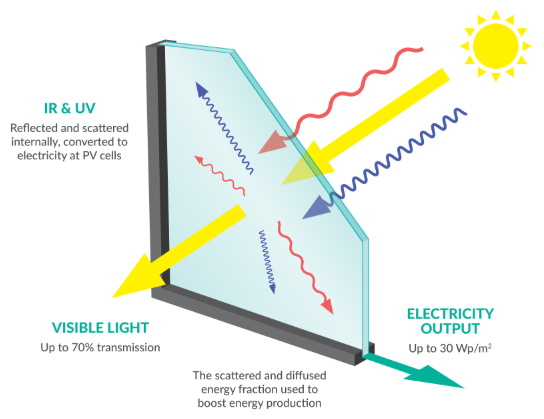
Transparent solar glass utilizes organic photovoltaic (OPV) materials, quantum dots, or perovskite-based thin films that selectively absorb non-visible wavelengths of sunlight (infrared and ultraviolet). Visible light passes through the glass, preserving transparency, while absorbed light is converted into usable electricity.
3.2 Components
Main components of transparent solar glass comprise:
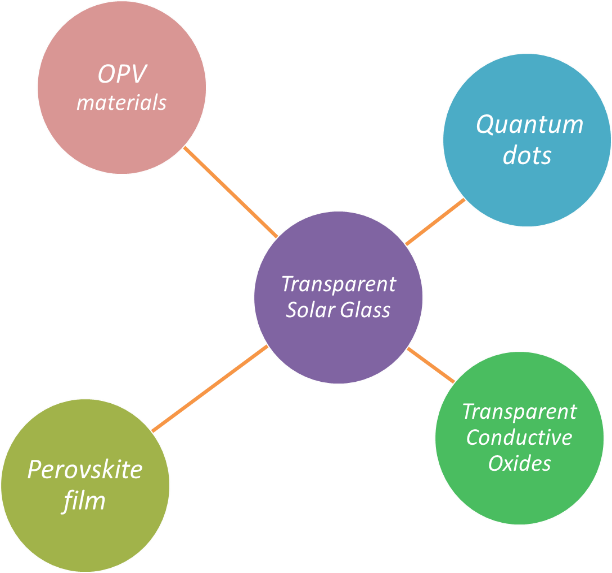
- Organic photovoltaic (OPV) materials: Lightweight, flexible, and customizable.
- Quantum dots: Nanocrystals engineered for wavelength selectivity.
- Perovskite-based thin films that selectively absorb non-visible wavelengths of sunlight.
- Transparent Conductive Oxides (TCOs): Indium tin oxide (ITO) or graphene for electrical conductivity without blocking visible light.
3.3 System Configuration
The optimized STE window consists of a wavelength-selective film coated over the glass surface, coupled with thermoelectric modules attached along the edges of the window.
- The film continuously absorbs ultraviolet (UV) and near-infrared (NIR) radiation and converts it into heat.
- Heat is laterally conducted across the film to the hot side of the thermoelectric modules.
- The glass substrate acts as a thermal insulator, minimizing heat losses to the environment.
- A stable temperature difference is established across the thermoelectric devices, enabling efficient power generation based on the Seebeck effect.
3.4 Efficiency Considerations
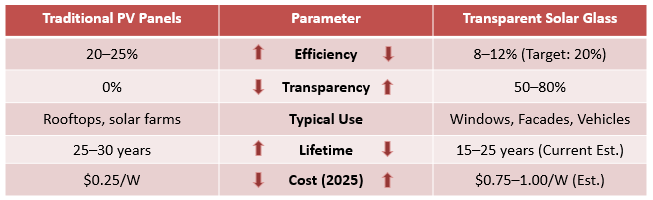
Current transparent solar glass prototypes achieve 8-12% efficiency, with research targeting efficiencies up to 20%. While lower than traditional silicon solar panels (~20-25%), the ability to integrate into large surface areas like skyscraper windows offers significant aggregate power generation.
Quantitative Comparisons
4. Benefits of Transparent Solar Glass
- Dual Functionality: Serves simultaneously as architectural glass (allowing natural daylight and visibility) and as an energy-harvesting surface, reducing the need for separate installation of bulky photovoltaic panels.
- High Visible Light Transmittance: Maintains clear transparency with visible light transmission typically in the range of 70-90%, ensuring building interiors remain naturally lit without compromising aesthetics.
- Wavelength-Selective Absorption: Absorbs ultraviolet (UV) and near-infrared (NIR) radiation while allowing visible light to pass, protecting building interiors from harmful UV exposure.
- Energy Conversion Capability: Converts absorbed non-visible solar energy into electricity with demonstrated output including voltages up to 3.6-4.0 V per 0.01 m² module in prototype studies.
- Mechanical Durability: Fabricated with scratch-resistant coatings (up to 6H hardness) and encapsulated layers to withstand dust, moisture, and environmental wear.
5. Market Outlook and Competitive Analysis
5.1 Market Potential
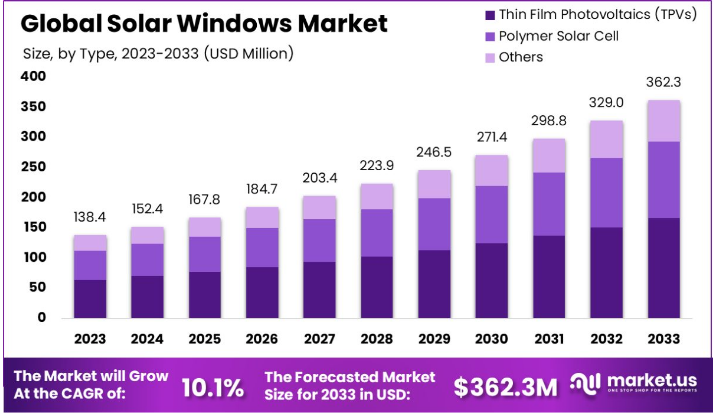
Cities account for over 70% of global energy consumption. Transparent solar glass provides an untapped avenue for decentralized energy generation by converting skyscraper windows into distributed solar power plants. The global solar windows market is projected to reach approximately USD 362.3 million by 2033, up from USD 138.4 million in 2023, reflecting a CAGR of 10.1% between 2024 and 2033.
5.1.1 Urban Energy Demand
Cities account for over 70% of global energy consumption. Transparent solar glass provides an untapped avenue for decentralized energy generation by converting skyscraper windows into distributed solar power plants.
5.1.2 Economic Viability
Initial costs remain high due to advanced material processing but long-term cost savings arise from reduced energy bills and potential subsidies. Market adoption is expected to grow with falling production costs and regulatory support.
5.1.3 Environmental Impact
Replacing traditional glass with solar glass reduces carbon footprints, aids in meeting net-zero emission goals, and contributes to sustainable urban development.
5.2 Regional Market Dynamics
| Region | Market Share | Key Drivers |
|---|---|---|
| North America | 32.3% (USD 44.5 million) | Aggressive solar capacity expansion and favorable policies |
| Europe | Strong growth | Stringent environmental regulations and high consumer awareness |
| Asia Pacific | Rapid growth projected | Increasing urbanization and expanding construction sector |
The global Solar Windows market is segmented into several key regions: North America, Europe, Asia Pacific, Middle East & Africa, and Latin America. The global solar windows market is projected to reach approximately USD 362.3 million by 2033, up from USD 138.4 million in 2023, reflecting a CAGR of 10.1% between 2024 and 2033. North America accounts for 32.3% of the market, valued at USD 44.5 million. The solar windows market is positioned for significant expansion, fueled by rising solar power generation and favorable government policies. In the United States, solar power output is projected to climb 75%, increasing from 163 billion kilowatt-hours (kWh) in 2023 to 286 billion kWh by 2025, according to the U.S. Energy Information Administration. Growth is being driven by an aggressive expansion of solar capacity, with planned projects expected to increase electric power sector capacity by 38%—rising from 95 gigawatts (GW) at the end of 2023 to 131 GW by the close of 2024. Within this push, the deployment of photovoltaic (PV) windows stands out as a key innovation, offering both enhanced energy efficiency and environmental benefits. Europe follows closely, benefiting from stringent environmental regulations and high consumer awareness regarding sustainable energy solutions. The region’s technological advancements and the presence of leading market players contribute to its robust growth. Asia Pacific is projected to exhibit rapid growth in the Solar Windows market due to increasing urbanization and the expanding construction sector, particularly in China and India. Governments in the region are actively promoting green building initiatives, which further fuel the demand for solar windows. The Middle East & Africa, while still nascent in this market, shows potential due to increasing infrastructure projects and the rising demand for energy-efficient buildings. Latin America, though smaller in market size compared to other regions, is expected to grow due to the improving economic conditions and the increasing adoption of solar technologies. Overall, with North America leading the way, each region contributes uniquely to the global market dynamics, influenced by local regulations, economic conditions, and technology penetration levels.
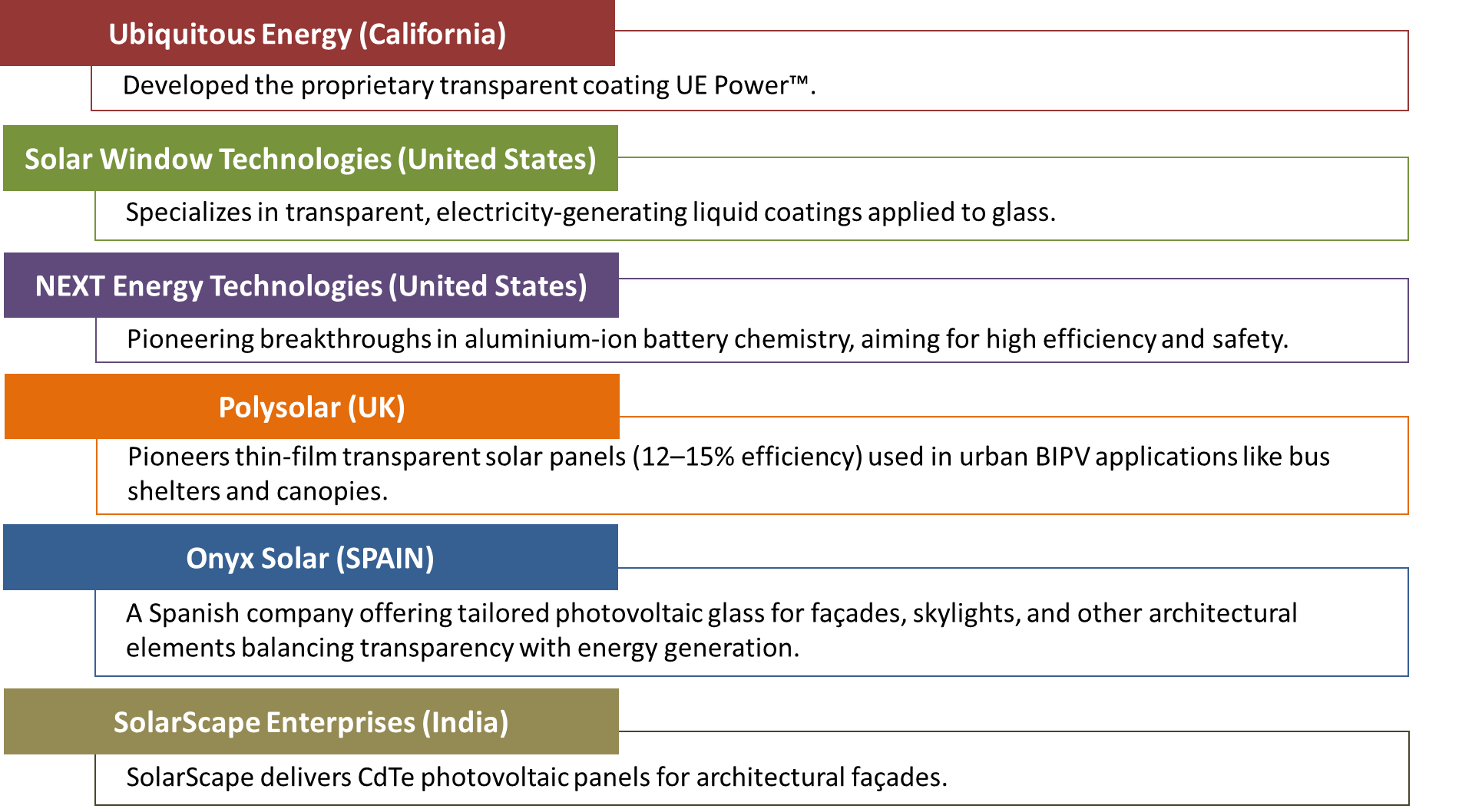
5.3 Market Players
Following are some listed company in the field of manufaturing relating to solar panel.
6. Case Studies
6.1 Skyscraper Installation: New York City Pilot Project
A 50-story office building in Manhattan replaced 30% of its façade with transparent solar glass in 2023. The installation generated approximately 1.2 GWh annually, equivalent to offsetting 850 metric tons of CO₂ emissions. The building reduced its reliance on the grid by 18%.
6.2 Greenhouse Application: Netherlands Agricultural Facility
A Dutch agricultural company integrated transparent solar glass into greenhouse rooftops, maintaining 70% visible light transmission for crops while producing 250 kWh per square meter annually. This dual-use model reduced operational energy costs by 35%.
6.3 Automotive Example: Toyota Prototype Vehicle
Toyota tested transparent solar windows on EV prototypes, increasing driving range by up to 10 km per day under optimal sunlight conditions. While modest, this supplementary energy reduces charging frequency and enhances sustainability.
7. Applications
| Application Area | Use Cases |
|---|---|
| Building-Integrated Photovoltaics (BIPV) |
|
| Automotive Sector |
|
| Consumer Electronics | Transparent displays and device screens with embedded photovoltaic layers |
8. Challenges
- Efficiency vs. Transparency Trade-off: Increasing efficiency often reduces clarity, requiring careful balance in design and materials.
- Durability: Long-term performance under weather conditions and UV exposure needs continued improvement.
- Scalability: Manufacturing at commercial scales remains a significant barrier to widespread adoption.
- Cost: Production costs are currently higher than conventional glass or traditional PV panels, limiting market penetration.
9. Future Directions
Advancements in nanomaterials and perovskite research are expected to raise efficiency and lower costs. Integration with smart building systems will optimize energy management, while widespread deployment could transform urban infrastructure into net energy producers. As research and technology advance, combining transparent solar glass with intelligent building systems promises more dynamic and effective energy management.
10. Conclusion
Transparent solar glass has the potential to transform the way society captures and utilizes solar energy. Combining functionality with aesthetic appeal, it offers cities and industries a sustainable energy solution without sacrificing design. Case studies demonstrate its feasibility, while quantitative analyses shed light on both its strengths and limitations. Although technical and economic challenges persist, ongoing innovation is steadily advancing this technology toward large-scale commercialization, promising a future where every window becomes a source of clean energy.