Floating House: Next-Generation Earthquake Mitigation Technology
Abstract
The idea of a floating or levitating house may sound futuristic, yet it is rapidly becoming a reality in earthquake-prone countries like Japan. Facing frequent seismic activity due to its position on the Pacific Ring of Fire, Japan has pioneered several innovative technologies to protect buildings from earthquake damage. One such innovation is the concept of levitating homes, where the structure momentarily lifts off the ground to avoid transmitting destructive seismic waves. This whitepaper explores two promising levitation technologies—fluid cushion-based lifting and magnetic levitation. It reviews the background and challenges of earthquake-prone construction, analyzes the proposed solutions, and discusses real-world implementations and results. The aim is to assess the practicality and future potential of levitating houses as a next-generation earthquake mitigation strategy.
1. Introduction
Earthquakes pose one of the most persistent and devastating natural threats to human habitation, particularly in geologically vulnerable regions like Japan. As a nation situated on the Pacific Ring of Fire, Japan experiences frequent and intense seismic activity, necessitating continuous innovation in structural resilience and disaster mitigation. While traditional earthquake-resistant architecture has significantly reduced damage, it often falls short during high-magnitude or multi-directional quakes.
In response to these limitations, researchers and engineers have begun to explore groundbreaking solutions that move beyond conventional construction practices. Among the most intriguing of these is the concept of the levitating house—a structure that can momentarily detach from the ground during seismic events, thus avoiding the transmission of destructive ground motion.
This whitepaper delves into the evolving concept of levitating houses, examining the technologies behind fluid cushion-based lifting and magnetic levitation. It analyzes their operational mechanisms, current implementation in Japan, and future potential. In doing so, the paper aims to assess the feasibility, advantages, limitations, and market readiness of these emerging technologies as a proactive defense against earthquakes. With ongoing research and targeted innovation, levitating house systems could redefine the way we build in seismic zones—shifting from passive resistance to active adaptation.
2. Background
2.1 Earthquake Risk in Japan
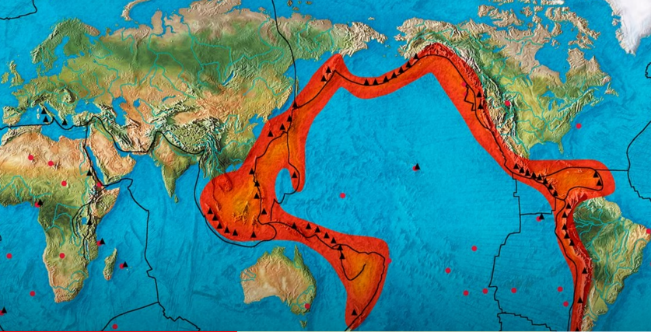
Japan is one of the most earthquake-prone countries in the world, situated on the "Pacific Ring of Fire" where four tectonic plates — the Pacific, Philippine Sea, North American, and Eurasian — converge. This geographical positioning subjects the region to frequent and intense seismic activity.
2.2 Earthquake Types and Seismic Waves
Earthquakes can be classified into:
- Tectonic – Caused by the shifting of Earth's crustal plates.
- Volcanic – Resulting from magma-induced rock fractures.
- Collapse – Due to the collapse of underground voids.
- Explosion – Triggered by artificial detonations.
Seismic waves generated during earthquakes are:
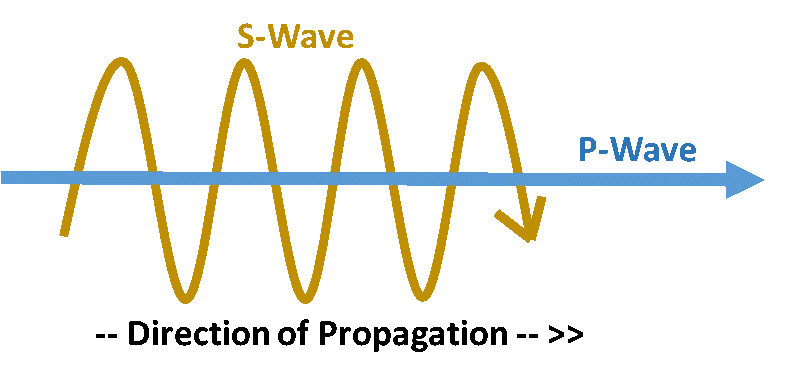
- P-waves (Primary) – Fast, compressional waves.
- S-waves (Secondary) – Slower, side-to-side motion.
- Love waves – Surface waves causing horizontal ground shearing.
- Rayleigh waves – Surface ripples similar to ocean waves.
2.3 Historical Context
Some of the strongest recorded earthquakes include:
| Location | Magnitude |
|---|---|
| Valdivia, Chile (1960) | 9.5 |
| Alaska (1964) | 9.2 |
| Sumatra, Indonesia (2004) | 9.1 |
| Tohoku, Japan (2011) | 9.0 |
| Kamchatka, Russia (1952) | 9.0 |
There must be some efficient solution to counter the effect of earthquake.
3. Problem Statement
Despite extensive safety measures, conventional buildings remain inherently vulnerable to high-magnitude and multi-directional earthquakes. Key issues include:
- Ground coupling: Even with isolation, buildings are connected to the ground and thus transmit some seismic force.
- Limited response time: Structural systems may not react fast enough to protect against initial shockwaves.
- Retrofitting challenges: Existing buildings are difficult and expensive to upgrade using traditional methods.
This highlights the need for next-generation solutions that offer active separation from ground motion, rather than relying solely on passive resistance.
4. Proposed Solution: Levitating House Technology
4.1 Existing Earthquake Mitigation Technologies in Japan
Japan already employs several advanced techniques:
- Early Warning Systems: Deliver alerts through various media seconds before tremors occur.
- Seismic Isolation Systems: Use base isolation to decouple buildings from the ground.
- Seismic-Resistant Design: Structural reinforcements using flexible and robust materials.
- AI & Smart Cities: AI-driven analysis for optimal construction zones and risk prediction.
- Simulation Tools: Public education using VR and real-event recreations.
- GNSS Monitoring: Nation-wide crustal movement detection via over 1,300 GNSS stations.
4.2 Floating House Concept
4.2.1 Fluid Cushion-Based Lifting
This method uses an air or fluid-filled cushion to lift the house slightly (3–4 cm) off a secondary platform during seismic activity.
Mechanism:
- Sensors detect tremors.
- Compressors inflate fluid cushions instantly.
- Upper platform with the house remains stable while the lower platform absorbs vibrations.
- Once the quake subsides, cushions deflate, restoring the house to its original position.
Advantages:
- Fast response (~0.5–1 second).
- Effective for small-to-moderate earthquakes.
- Does not require continuous energy input.
Challenges:
- Less effective during large or multidirectional quakes.
- Requires reliable power backup.
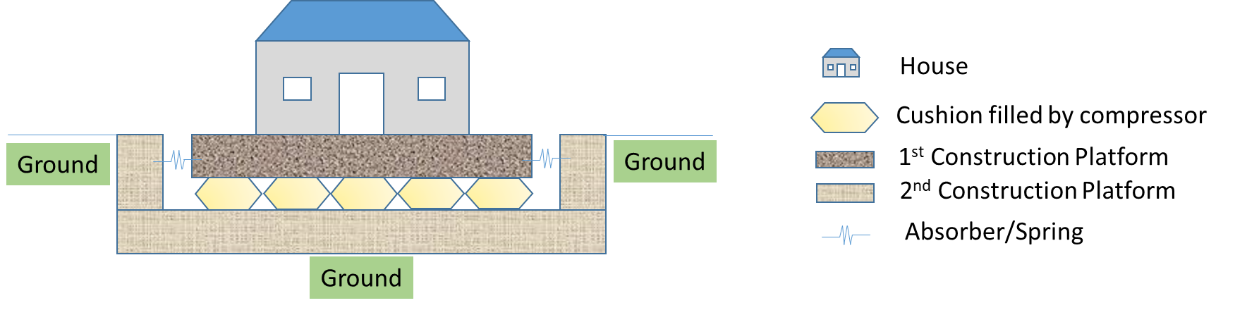
Fluid Cushion-Based Lifting System
4.2.2 Magnetic Levitation (MagLev)
A more futuristic approach, magnetic levitation uses strong repulsive forces to lift and suspend the structure without mechanical parts.
Mechanism:
- Two magnetic platforms with opposing poles create a repelling force.
- The structure is suspended in the air, completely isolated from ground movement.
Advantages:
- Potential for continuous seismic isolation.
- No moving parts or mechanical inflation required.
Limitations:
- Requires extremely powerful magnets and high energy.
- Technology still under research and not widely deployed.
- High installation and maintenance cost.
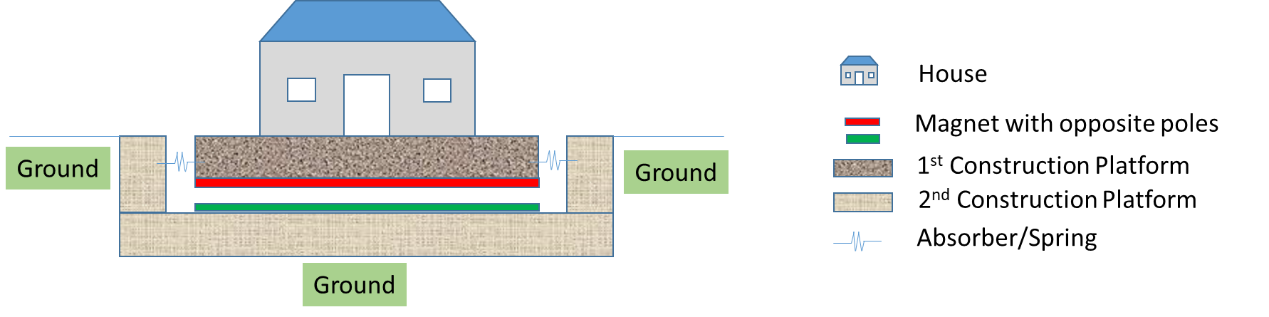
Magnetic Levitation (MagLev) System
5. Results / Data: Real-World Implementation
5.1 Case Study: Air Danshin Systems Inc.
Air Danshin Systems Inc.
Founded by inventor Shoichi Sakamoto, Air Danshin Systems is the first company to commercialize fluid-based levitation for houses.
Key Data Points:
- Deployment: Over 100 homes and buildings in Japan.
- Response Time: 0.5 to 1 second after seismic detection.
- Lifting Height: 1–3 cm.
- Power Backup: System includes an emergency power supply.
Observations:
- Gained attention after the 2011 Tohoku earthquake.
- Effective against mild to moderate seismic activity.
- Stability is reduced during strong or complex seismic events.
Limitations Noted:
- Inadequate for earthquakes with intense horizontal or rotational forces.
- Lifting height may not be sufficient for large magnitude shocks.
- Scalability in dense urban settings is still under evaluation.
6. Competitive Analysis
6.1 Existing Competitor
Currently, the only known competitor is Air Danshin Systems, which has developed an air-filled chamber system to lift houses during earthquakes. However, the technology has certain limitations, particularly in terms of the lifting mechanism and its sustainability during large or multi-directional earthquakes, indicating the need for further development and innovation.
6.2 Opportunity Areas for Differentiation
- Development of multi-directional resilience in floating systems.
- R&D into magnetic-based levitation with energy-efficient operation.
- Integrating AI for predictive control of lifting mechanisms.
- Designing for urban retrofitting and modular installations.
7. Conclusion
As the frequency and intensity of seismic events continue to rise, levitating houses present a bold new frontier in disaster resilience. By actively lifting buildings away from ground motion, these systems offer a proactive approach to earthquake mitigation. While fluid cushion-based systems have shown promising real-world results, magnetic levitation remains a high-potential, long-term innovation.
Future efforts should focus on:
- Enhancing multi-directional stability.
- Improving energy efficiency of MagLev systems.
- Integrating AI for predictive response.
- Developing scalable solutions for retrofitting urban structures.
Levitating houses may still be in their early stages, but they symbolize a paradigm shift—from resisting nature's forces to evading them altogether. With sustained research and collaboration between engineers, architects, and policymakers, this concept could become a foundational element of earthquake-resilient infrastructure worldwide.
8. References
- https://parametric-architecture.com/japans-floating-house-solution/
- https://www.asme.org/topics-resources/content/made-in-japan-earthquake-proof-homes
- https://theindexproject.org/award/nominees/243
- https://www.scirp.org/journal/paperinformation?paperid=115095
- https://www.youtube.com/watch?v=BMBbLb9hUFA





-Sensors-Next-Generation-Flexible-Devices/Wrinkled-Silver-Nanowire-AgNW-Sensors-Next-Generation-Flexible-Devices.png)


