Executive Summary
Cancer remains the leading cause of death worldwide, making early detection and effective treatment critical for improving patient health. Traditional approaches such as tissue biopsy were considered a fine technique for cancer diagnosis. In recent years, liquid biopsy has emerged as a minimally invasive alternative for analyzing tumors in bodily fluids such as blood, urine, and saliva. Liquid biopsy provides real-time monitoring of tumors and detection of minimal residual disease, enabling more personalized and adaptive cancer management. A liquid biopsy technique focuses on detecting circulating tumor cells (CTCs), circulating tumor DNA (ctDNA), and extracellular vesicles (EVs).
Liquid biopsy offers several advantages over traditional biopsies, such as improved patient comfort, safety, repeatability, and faster results. Adaptive therapy adjusts the treatment based on tumor response using liquid biopsy data, further helping in improving quality of life. Ongoing advancements in molecular biology, bioinformatics, and clinical oncology are driving liquid biopsy towards clinical use. Liquid biopsy promises to become a key element of precision oncology, offering a personalized and predictive approach to cancer care.
1. Introduction
Cancer is the primary cause of death in the world and is a major public health concern. Timely detection with appropriate therapy plays an important role in enhancing the chances of survival. At present, the most reliable technique for cancer diagnosis is still tissue biopsy, but this technique does not evaluate tumoral heterogeneity. In recent years, there has been a progressive transition from invasive cancer diagnostic techniques (i.e., tissue biopsy) to non-invasive techniques, with liquid biopsy leading as a key alternative. Tumor-associated material can be analyzed through liquid biopsy by sampling biological fluids such as blood, urine, saliva, etc. The evolving role of liquid biopsies involves selecting adaptive therapies, tracking treatment response, determining therapy duration, and treatment planning. Liquid biopsy with adaptive therapy is an approach that continuously adjusts based on the tumor's change profile and facilitates personalized and flexible cancer management. This integration improves efficiency, reduces toxicity, and also improves patient survival and quality of life.
2. What is Liquid Biopsy?
Liquid biopsy is a non-invasive diagnostic technique used to detect and analyze tumor cells that are released into body fluids, basically blood but also urine, saliva, and any other bodily fluids. It provides a molecular picture of the tumor and is a key alternative to traditional tissue biopsy techniques. Unlike traditional tissue biopsies, which require surgical removal of targeted tissue, liquid biopsy provides a way to obtain clear information about a tumor using a non-invasive approach.
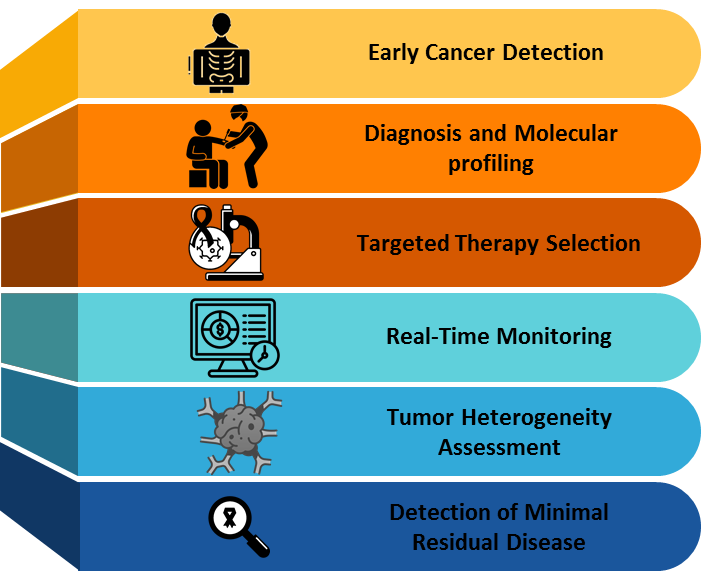
2.1 What liquid biopsy is used for?
3. Adaptive Therapy in Oncology
Adaptive therapy is an innovative and developing approach for cancer treatment. It aims to control, rather than eliminate, the tumor by regulating therapy based on how the cancer evolves during treatment. Unlike traditional treatments that focus on destroying as many cancer cells as possible, adaptive therapy aims to control tumor growth over time to delay or prevent resistance. [13]
3.1 Adaptive therapy works with a different approach by:
- Preserving some treatment-sensitive cells to slow down the growth of resistant cells.
- Increasing the dose or ceasing the treatment to maintain the balance for adaptive therapy.
- Adjusting the treatment in real-time based on how the tumor is responding.
3.2 Why it matters?
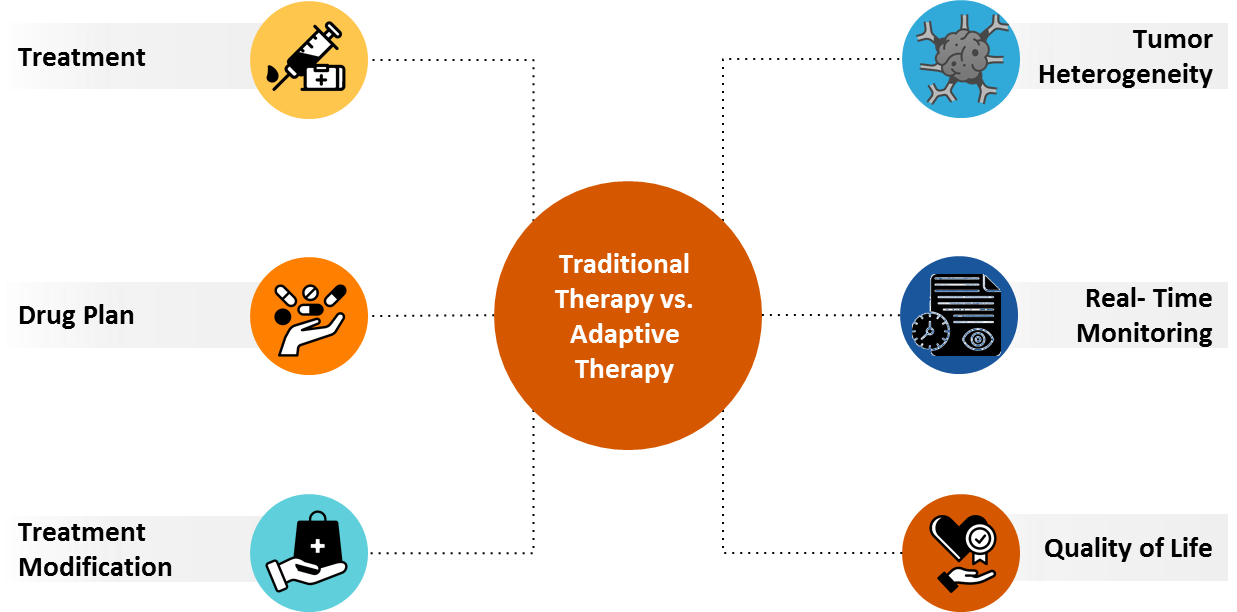
| Aspect | Traditional Therapy | Adaptive Therapy |
|---|---|---|
| Treatment | Remove as many cancer cells as possible | Controls tumor growth and delays drug resistance |
| Drug Plan | Continuous high-dose treatment | Dynamic, Personalized dosing (i.e., intermittent or reduced) |
| Treatment Modification | Fixed schedule and dose | Adjusted based on tumor response and biomarkers |
| Tumor Heterogeneity | Might eliminate sensitive cells and leave resistant clones | Maintains a balance between resistant and sensitive cells |
| Real-Time Monitoring | Usually limited, or done on fixed intervals (weekly, monthly etc.) | Done continuously or frequently using sensors and biomarkers |
| Quality of life | Significantly affected | Typically better maintained |
4. Key Liquid Biopsy Techniques
Liquid biopsy approaches, including the analysis of circulating tumor cells (CTCs), circulating tumor DNA (ctDNA), circulating miRNAs, and tumor-derived extracellular vesicles (EVs), are the most common tumor-related biomarkers assessed in liquid biopsies so far. They offer an effective way to diagnose and track progress over time. [12]
Three major Liquid biopsy techniques:

4.1 Circulating tumor cells (CTCs) Analysis
CTCs are cells released from primary and metastatic tumors that enter the blood or lymphatic vessels of cancer patients and circulate in the peripheral blood. CTCs are a key component in the metastatic process, where cancer cells spread to other parts of the body. Metastasis involves multiple steps that depend on the presence of CTCs found in bone marrow. [5], [6]
Characterization of CTCs uses methods such as PCR, flow cytometry, image-based immunologic approaches, immunomagnetic techniques, and microchip technology with specific primers for tissues, organs, tumor-specific transcriptions, or for tumor-specific mutations, translocation, or methylation patterns unique to the tumor. [6]
4.2 Circulating Tumor DNA (ctDNA) Analysis
ctDNA (circulating tumor DNA) are fragments released by tumors into the blood, also known as Cell-free DNA (cfDNA). The amount and stability of ctDNA can be used to distinguish between cancer patients and healthy individuals. The overall level of ctDNA is generally higher in cancer patients than in healthy individuals and appears to increase with stage and metastasis. [7]
Currently, highly sensitive and specific methods for the detection of ctDNA have been developed. Technologies are classified into two sub-categories: (a) Targeted techniques designed to detect mutations in a collection of predetermined genes, and (b) Untargeted methods used for whole-genome sequencing. Characterization of ctDNA uses methods such as qPCR (quantitative PCR), dPCR (digital PCR), and ddPCR (droplet digital PCR). [6]
4.3 Extracellular vesicle (EVs) Analysis
Extracellular vesicles are equally important in liquid biopsy techniques due to their ability to carry biomarkers indicative of cancer. They can be considered a molecular fingerprint of their cell of origin, making them suitable as cancer biomarkers. EVs can provide both quantitative and qualitative data. Quantitative data reveals EV levels, the existence of malignancy, and tumor density. Easily accessible qualitative information is achieved by the molecular characterization of EV components, including nucleic acids and proteins. [6] Techniques to detect EVs include Flow cytometry, Nanoparticle tracking analysis, Small angle X-Ray scattering, In-situ EV assays, and ELISA-based methods. [9]
5. Benefits of Liquid Biopsy in Cancer management
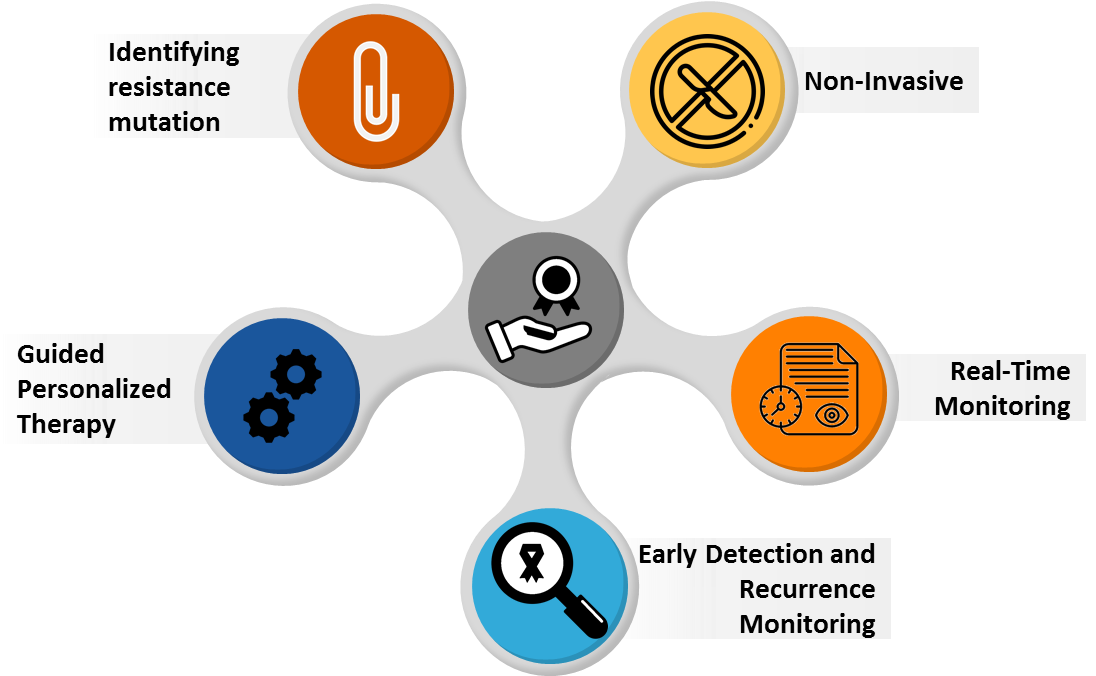
- Non-invasive and safe: Liquid biopsy analyzes biomarkers in bodily fluids like blood, urine, or saliva rather than surgically removing tissue. This eliminates discomfort as there is no surgical procedure. It is easier to repeat and provides comprehensive tumor analysis. [5]
- Real-time monitoring: Liquid biopsies provide real-time cancer monitoring by analyzing ctDNA, CTCs, and other cancer-related biomarkers in a blood sample. This non-invasive technique helps in tracking tumor evolution and treatment response. [8]
- Early detection and Recurrence monitoring: Liquid biopsy allows for frequent sampling and real-time tracking of tumor behavior. It helps in identifying mutations and assessing minimal residual disease (MRD)—cancer cells that remain after treatment—allowing for timely interventions to prevent cancer return. [8]
- Guided personalized therapy: Liquid biopsy plays an important role in precision or adaptive therapy by providing a minimally invasive way to analyze tumor DNA (ctDNA) and other molecules. This helps in selecting the most effective treatment strategies and evaluating outcomes. [9]
- Identifying resistance mutation: Liquid biopsy helps in identifying mutations through the detection and analysis of CTCs, ctDNA, and exosomes released from tumors into the bloodstream. [5], [6]
6. Liquid Biopsy vs. Traditional Biopsy
| Feature | Liquid Biopsy | Traditional Biopsy | Reference |
|---|---|---|---|
| Invasiveness | Minimally invasive; requires only a blood sample or other body fluid. | Invasive; requires surgical or needle biopsy. | [5] |
| Patient comfort & safety | Low risk of complications and minimal discomfort. | High risk of complications (pain, bleeding, infection). | [8] |
| Repeatability | Easily repeated over time for continuous monitoring. | Limited and depends on the patient's condition. | [5] |
| Real-Time Monitoring | Enables continuous tracking of tumor change and therapy response. | Provides only single time-point snapshots of tumor status. | [8] |
| Tumor Heterogeneity Detection | Captures DNA from multiple tumor sites for better analysis. | Samples only one tumor site, potentially missing heterogeneity. | [6] |
| Result Duration | Results available within a few days. | Can take days to weeks depending on the analysis. | [7] |
| Accessibility | Works even when tumors are hard to access (e.g., brain, bone). | Requires physical access to the tumor site. | [9] |
7. Applications of liquid biopsy according to the type of cancer
| Cancer Type | Application | Reference |
|---|---|---|
| Lung Cancer |
|
[10] |
| Breast Cancer |
|
[11] |
| Colorectal Cancer |
|
[11] |
| Prostate Cancer |
|
[12] |
| Pancreatic Cancer |
|
[13] |
| Ovarian Cancer |
|
[10] |
| Melanoma |
|
[11] |
| Bladder Cancer |
|
[13] |
| Brain Tumors | Analysis of cerebrospinal fluid (CSF) for ctDNA and tumor markers. | [9] |
8. Conclusion
Liquid biopsy is a transformative advancement in cancer diagnosis and management, offering a minimally invasive, safe, and repeatable alternative to traditional tissue biopsies. By analyzing tumor-derived components such as CTCs, ctDNA, and extracellular vesicles in body fluids, liquid biopsy provides a complete molecular profile of tumors, capturing tumor heterogeneity and enabling real-time monitoring of disease and treatment response. It also enhances early cancer detection, guides personalized adaptive therapy, helps in identifying mutations, and improves patient outcomes and quality of life. Furthermore, liquid biopsy’s ability to access difficult tumors and provide rapid results makes it a highly valuable technique across various cancer types. As research and technology advance, combining liquid biopsy with adaptive therapy promises more dynamic and effective cancer management, offering hope for better survival rates and reduced treatment toxicity.
9. Future Directions
As liquid biopsy continues to evolve, its clinical application is rapidly increasing. Unlike traditional diagnostic techniques, liquid biopsy offers a minimally invasive, repeatable, and real-time method to detect, analyze, and monitor tumor behavior. Ongoing research and innovations in molecular biology, bioinformatics, and clinical oncology are expanding the development of specific liquid biopsy platforms. These advancements not only enhance our understanding of tumor behavior but also pave the way for precision oncology, where therapies are specific to the unique molecular profile of each patient. As a rapidly advancing field, liquid biopsy is emerging as a key tool for early cancer detection, guiding treatment decisions, monitoring drug resistance, and enabling long-term disease tracking. The future of cancer care will rely on the dynamic, data-rich, and patient-centered approach that liquid biopsy enables—offering a more personalized, adaptive, and predictive pattern in oncology.