1. Introduction
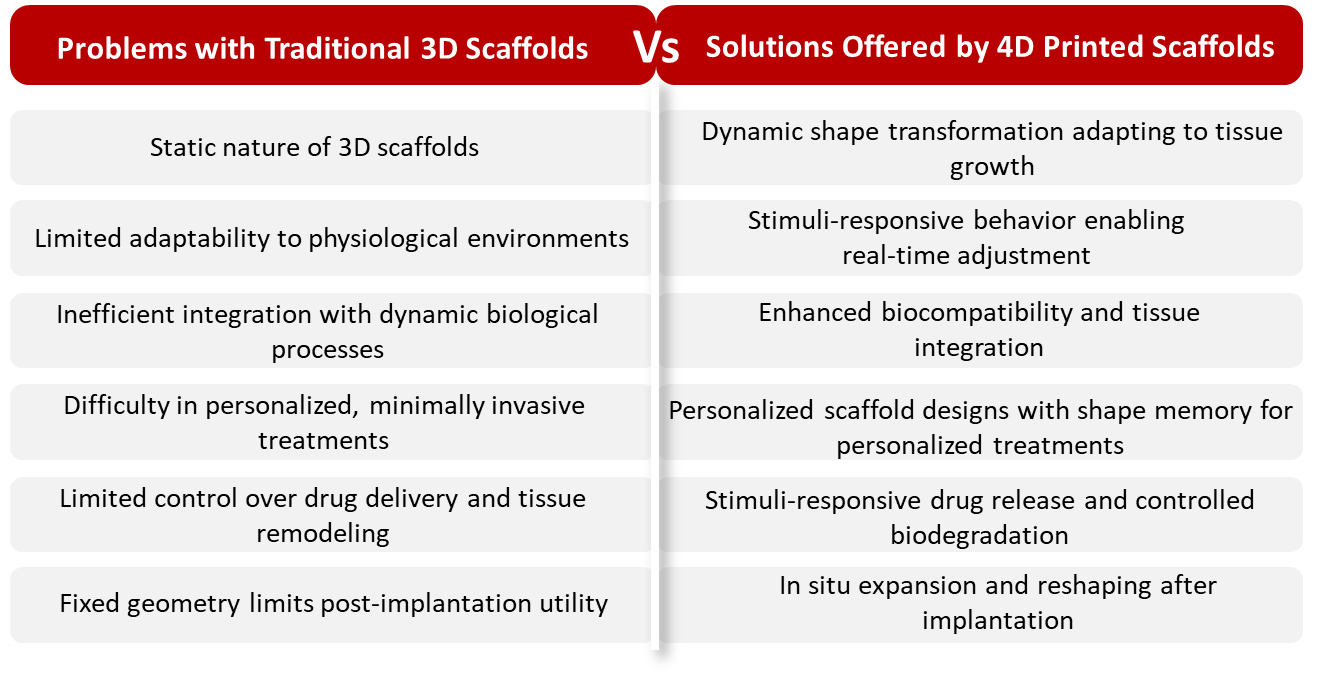
The development of three-dimensional (3D) printing technologies has received considerable attention in biomedical applications. 3D printing has the ability to design patient-specific scaffolds with high spatial precision. However, 3D printing has its own limitation: 3D printed objects are static and unable to dynamically change shape when subjected to external stimuli.
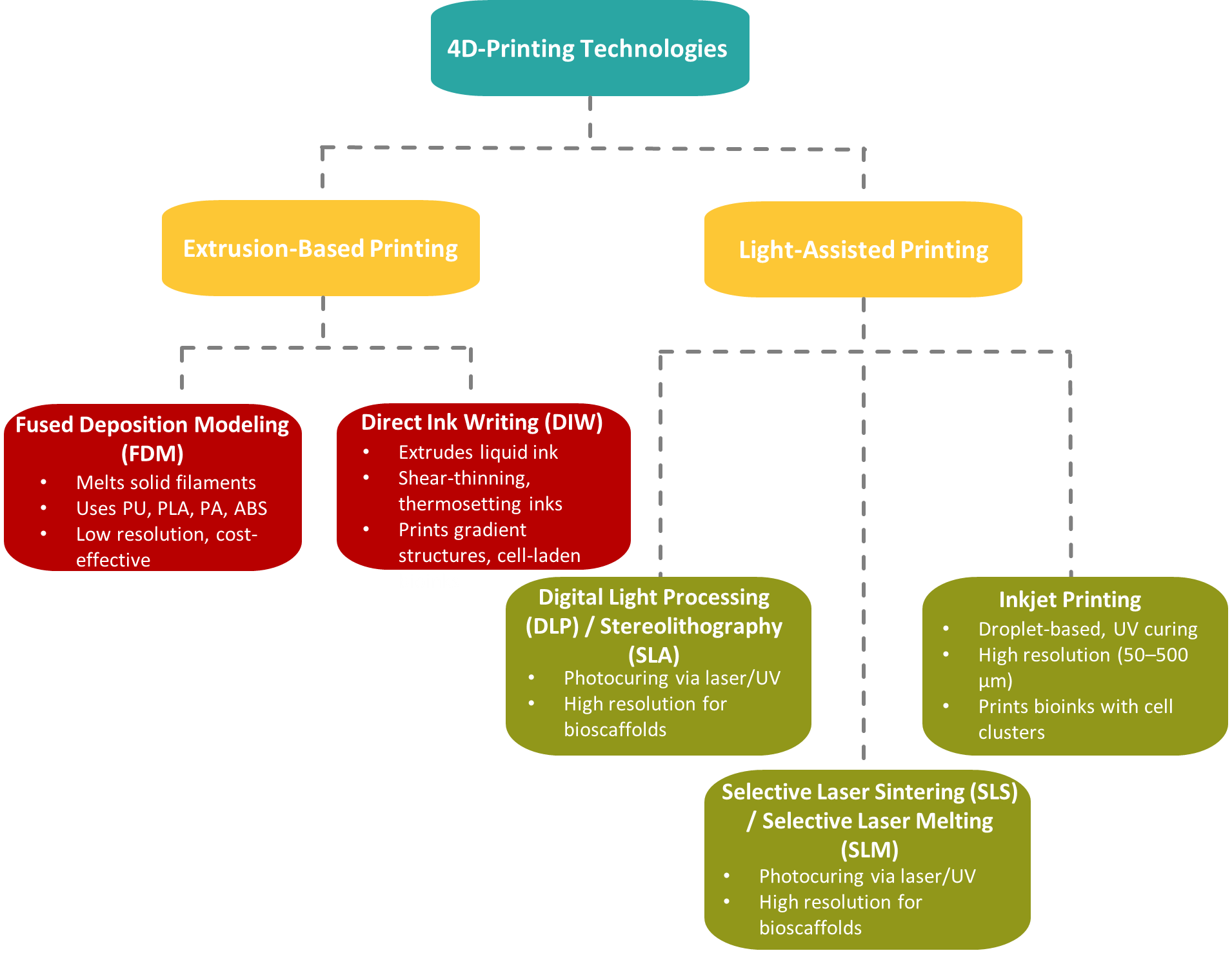
To overcome above limitations, researchers have explored the emerging technology of four-dimensional (4D) printing. 4D printed scaffolds are advanced, smart biomaterial structures created using 4D printing technology, where a fourth dimension, time, is incorporated into 3D printing. 4D scaffolds are designed to mimic the natural extracellular matrix (ECM) and provide an appropriate environment for cell growth, differentiation, and formation of new tissues. 4D printed scaffolds have the ability to change their properties, shape, and even functionality with time in response to specific external stimuli such as temperature, pH, humidity, light, or magnetic fields.
In this white paper, the potential of 4D printed scaffolds in biomedical applications, challenges, and future directions is discussed.
2. The Problem-Solution Matrix in 4D Printing
3. Stimuli-Responsive Materials for 4D Printing
3.1. Shape memory polymers (SMPs)
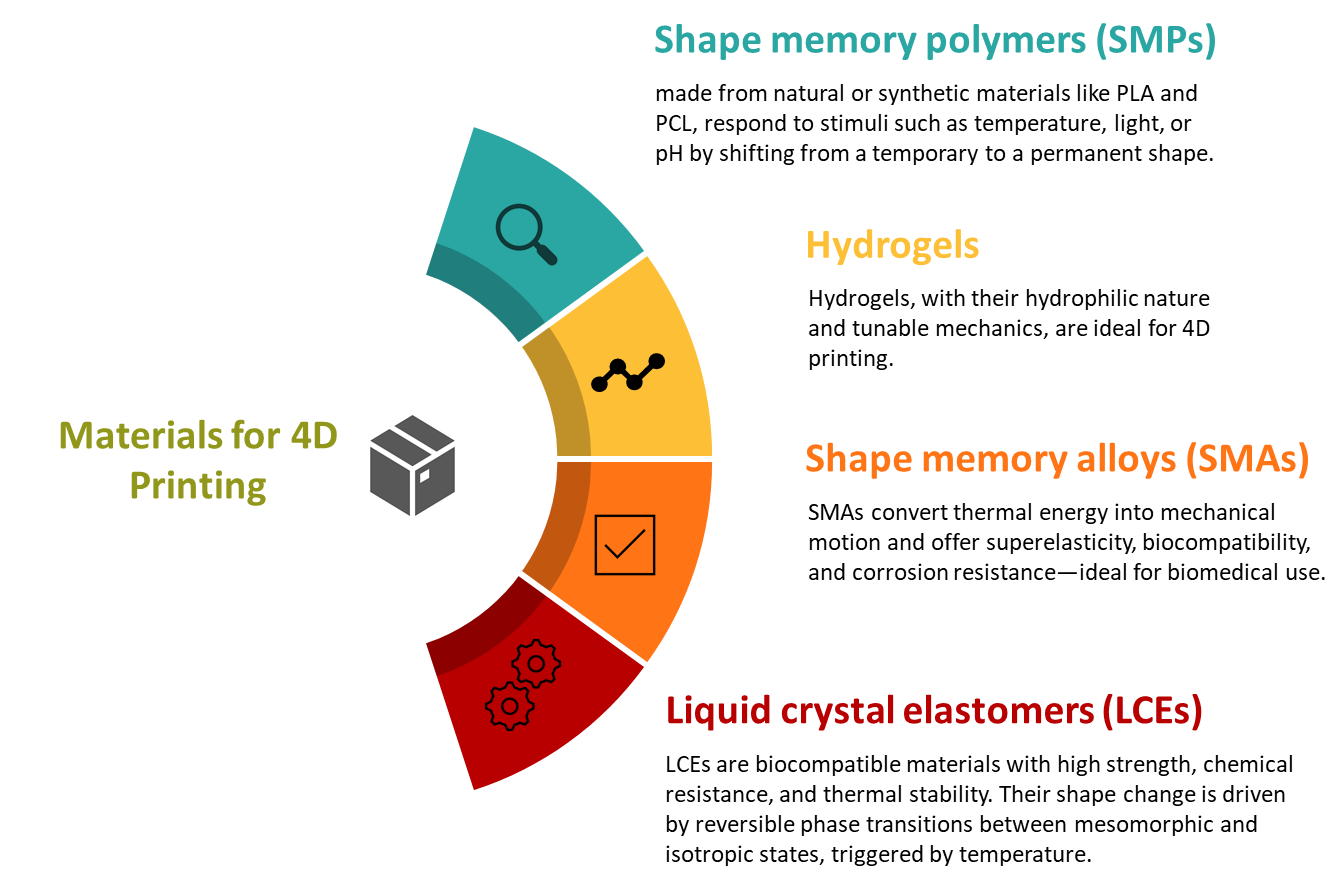
Shape memory polymers (SMPs) are well known for their stimuli-responsive properties. They are made up of natural polymers such as polypeptides and polysaccharides, or from synthetic polymers such as polylactic acid (PLA) and polycaprolactone (PCL). SMPs, when exposed to external stimuli such as temperature, light, or pH, can transition from temporary to permanent shapes. Such morphological transformations can vary from simple bending to more complex forms, such as helixing or topographical modifications, depending on the mechanical characteristics of the polymers.
The SMP’s shape change includes two states, i.e., a temporary programmed shape and a permanent recovery shape. Thermo-responsive SMPs operate based on two key molecular components: a “switch,” which undergoes a thermal transition at the glass transition temperature (Tg) and forms physical crosslinks that fix the polymer into a temporary shape; and a “net-point,” which defines the permanent shape of the material. On a macroscopic level, the shape of SMPs can be programmed under external stress when the temperature is above Tg and can remain stable at a cooled temperature. The shape returns to its original form when the temperature increases above Tg.
3.2. Hydrogels
Hydrogels due to their unique hydrophilic characteristics and versatile mechanical properties are promising candidates for 4D printing. Hydrogels primarily rely on their swelling and de-swelling characteristics for exhibiting the desired shape transformations. These swelling characteristics can be controlled by external stimuli, including light, pH change, and solution concentration.
Generally, hydrogels forms insoluble networks by inner covalent or physical crosslinking of hydrophilic polymers. They can be stabilized through either chemical bonding or physical bonding. A balance between swelling ratio and mechanical strength is still a challenge in hydrogel research. So, researchers must carefully optimize this balance to ensure the printed hydrogel works well.
3.3. Shape memory alloys (SMAs)
Shape memory alloys (SMAs) have shape memory effects that change thermal energy into mechanical energy. They exhibit superelastic behavior, biocompatibility, and corrosion resistance, which make SMAs an ideal choice for biomedical uses. Nickel-titanium (NiTi) alloy is particularly well known for shape recovery and superelastic strain, and thus is extensively used in clinical orthopedics. These materials can exist in three particular crystal structures: austenite, detwinned martensite, and twinned martensite, having three distinctive shape memory characteristics: one-way, two-way, and pseudoelasticity.
In a study, an SMA-based 4D robot prototype was developed that contained a shape-transformable spring coil and an arched sheet. Ni-Ti was used to fabricate a crawling robot; excitation of austenite and martensite phases was used to actuate functional motions. This controllable structure suggested the potential feasibility of this approach in minimally invasive surgery.
3.4. Liquid crystal elastomers (LCEs)
Liquid crystalline elastomers (LCEs) offer unique mechanical and functional characteristics due to their specialized molecular structures. These materials have superior mechanical strength, excellent chemical resistance, high-temperature stability, and biocompatibility. LCEs are mainly composed of liquid crystal chain units, which initiate phase transition from mesomorphic to isotropic states. The shape changing process of LCEs includes the liquid crystalline precursors aligning in the desired direction when the temperature is lower than the nematic–isotropic point, and this alignment becomes stable after the completion of crosslinking, with the conversion between these two states being reversible and visually identifiable.
In a study, superparamagnetic Fe₃O₄ nanoparticles were incorporated into LCE, allowing it to undergo a reversible magneto-thermal contraction upon contactless electromagnetic stimulation. These properties make LCEs suitable for a wide range of biomedical applications, such as surgical instruments, dental devices, orthopedic implants, and controlled drug delivery systems.
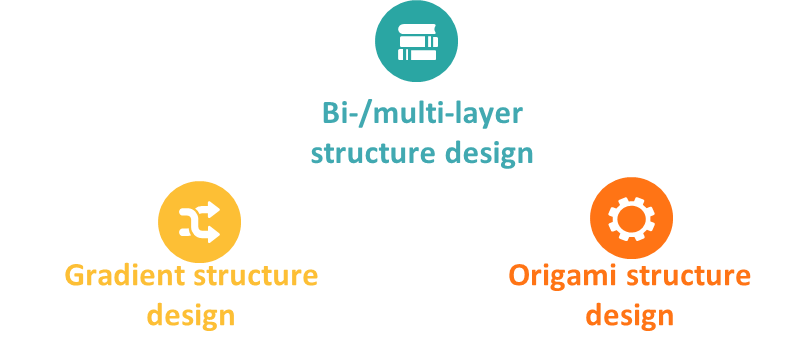
4. From Layers to Origami: Structural Design Modalities in 4D Printing
5. Biomedical Applications of 4D-Printed Structures
5.1. Bi-/multi-layer structure design
The bi-/multi-layer structures are widely used in designing 4D printed structures. These structures have two basic layers: a driving layer and a passive layer.
These structures are self-bending, self-rolling, and self-buckling, and are activated by moisture, light, and pH. For this reason, 4D printed structures are used in implants to repair organs such as vessels, trachea, and intestines, which have curved surface topology.
5.2. Gradient structure design
Gradient structures include spatial variations in material properties, geometry, or porosity within a scaffold. For photocuring bioinks, the intensity of light decreases as it penetrates deeper into the material in the presence of a photoinitiator and ultraviolet absorber. This results in a gradient in crosslinking density, where the top layer of the material has higher crosslinking density as it is closer to the light source, and the bottom layer has lower crosslinking density as it is farther from the light source. This uneven structure causes anisotropic swelling, leading to internal strain that induces shape deformation.
4.3. Origami structure design
Origami structures are widely used in biomedical applications due to their self-deployment ability. These structures can expand from a small volume to a large functional volume. The materials preferred for constructing these structures are SMPs that respond to thermal stimulation. The folding modes in origami structure-based devices are important, as these devices are designed to fold and unfold transversely or longitudinally.
6. Biomedical Applications of 4D-Printed Structures
6.1. Tissue engineering
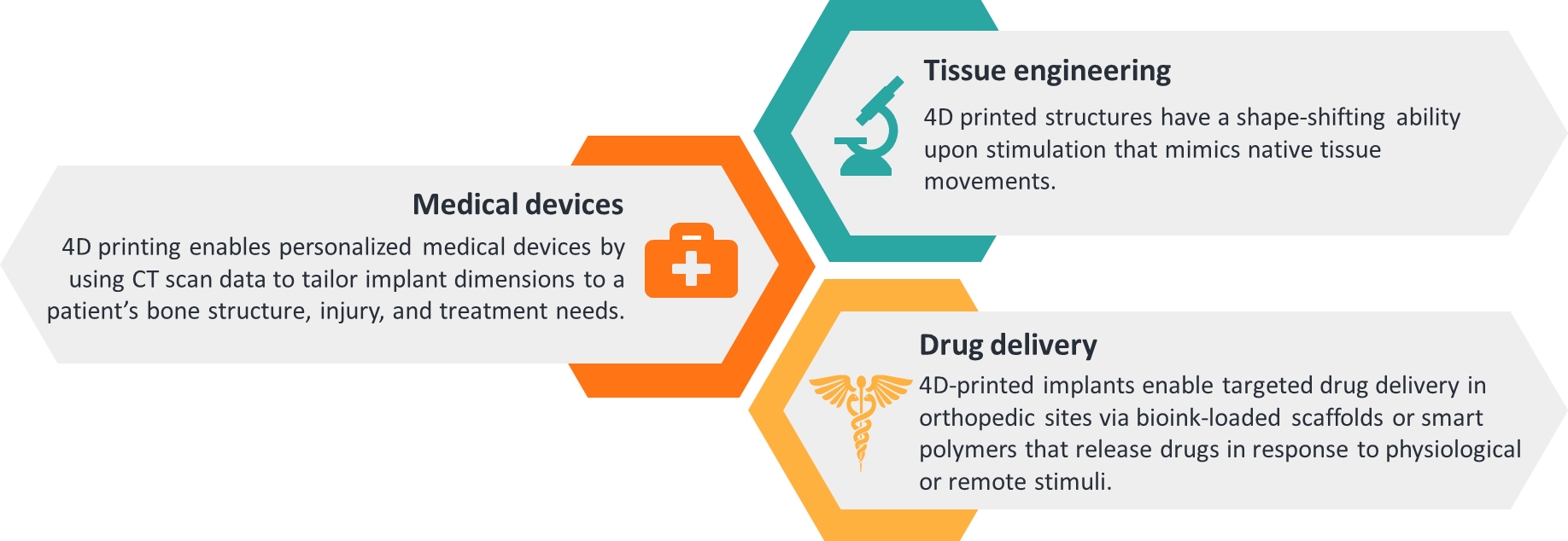
3D printing has emerged as a promising technology for constructing complex 3D structures that closely mimic native tissues. However, 3D printed structures remain static and cannot replicate the dynamic behavior of native tissues that change in response to shifts in tissue conformation. To overcome these limitations, 4D printed structures were created that can undergo shape change upon stimulation, thereby mimicking native tissue movements. To replicate natural bone tissue, it is necessary to create a functional scaffold, as this framework directly impacts the spatial arrangement of cultured cells and the interactions between multiple cells within the structure, thereby causing modulation of a range of cellular responses.
In a study, a porous bone scaffold was prepared comprising polylactide (PLA)/15 wt% hydroxyapatite (HA) using a direct heating 4D printer that facilitated shape memory functionality. The prepared bone structure had open pore spaces and was interconnected, forming a highly porous structure. In another study, spinal fusion surgery was performed to join two or more vertebrae to stop movement that caused pain. The researchers developed a layered scaffold, combining type I collagen for flexibility and hydroxyapatite for bone stiffness and conductivity. The prepared scaffold supported bone marrow stem cell growth and the formation of a new bone matrix in vitro.
6.2. Medical devices
The 4D printing technique is used for manufacturing personalized, custom-designed medical devices according to an individual’s specific situation. This technology allows physicians to precisely customize the dimensions of the implants based on the patient's bone structure, degree of injury, and treatment needs, using the patient's CT scan data to prepare the most appropriate implants and scaffolds for each patient.
In a study, 4D printing was used to successfully prepare an acetabular cup with superior performance. These acetabular cups, printed using this technology, can produce complex porous structures to adapt to the individualized needs of different patients and, thereby, can be used for long-term clinical treatment, which greatly improves therapeutic efficacy and surgical success rate. In another study, researchers reported a smart spinal implant technology for the treatment of spinal deformities and injuries. These smart spinal implants can be used for treating conditions like fractures, degenerative disc disorders, and scoliosis. These implants can restore spinal stability, improve surgical outcomes, and enhance patient quality of life.
6.3. Drug delivery
Drug delivery systems that are capable of delivering drugs to target sites in a controlled manner are of great promise in managing diseases while reducing toxicity. In orthopedic diseases, which involve specific local areas such as the fracture site, joint cavity, spine, etc., precise delivery of the drug to these sites is required while avoiding dilution and metabolism of the drug as it passes throughout the body. To achieve this, there are two methods to deliver drugs in 4D-printed implanted devices: first, by adding the targeted drugs in the initial bioink, and then these drugs can be released after the scaffold implantation. Although this method is simple, controlling the release rate of the drug is difficult, and on-demand release of the drug cannot be achieved. Second, by designing intelligent polymer networks or deformable devices with 4D printing. These devices can be actuated by physiological stimulation in vivo or via remote stimulation in vitro after implantation.
In a study, a bioinspired smart hydrogel capsule was designed via extrusion-based 4D printing, consisting of crosslinked PNIPAM (Poly(N-isopropylacrylamide)) hydrogel as the shell and the drug as the core. This 4D-printed core-shell structure was capable of delivering drugs on demand based on ambient temperature, and the release profile can be modified by adjusting the internal pore size of the hydrogel capsules. In another study, a pH-responsive hydrogel printed by femtosecond laser direct writing at the microscale was reported. The researchers designed a complex microcage that could capture and release microparticles due to different pore sizes in the expanded and contracted states, showing its potential in drug delivery systems.
7. Current Challenges in the Clinical Adoption of 4D-Printed Scaffolds
As discussed, 4D-printed scaffolds have shown great application potential, but they are still in the initial stage of development and face many challenges. In material selection, more diverse material types are required with better performance optimization to meet the special requirements in orthopedic treatment. In the case of biocompatibility, good compatibility of these smart materials with human tissue is necessary, and it requires in-depth investigation and research on the interaction mechanism with human physiology to ensure that there are no side effects. The printing technology also needs to be continuously improved for quality implant devices while increasing the printing speed. Additionally, the high cost of 4D-printed scaffolds limits their popularity. So, for widespread applications, it is necessary to reduce cost and enhance the operability of this technology.
8. Future Outlook
Although there are several challenges, the field of scientific research and engineering innovation is constantly exploring and innovating around these issues. 4D printing technology will continue to grow and evolve in the biomedical field and will bring better treatment experiences and results to patients. Despite being new, 4D printing has already shown its impact in the biomedical sector. Given the rapid progress in 4D printing, it's likely to reach its full potential in the near future, especially with advancements in affordable, high-resolution printers and, most crucially, the discovery of new biocompatible smart materials.
9. Conclusion
4D-printed scaffolds represent a significant leap forward in biomedical engineering, offering dynamic, responsive solutions tailored to individual patient needs. Their ability to mimic natural tissue behavior, deliver drugs to targets precisely, and adapt to physiological conditions makes them a powerful and useful tool in modern medicine. However, efforts must be made to address current limitations in material science, biocompatibility, and manufacturing scalability to fully realize their potential. By overcoming these limitations, 4D printing can revolutionize orthopedic treatments and broader healthcare applications, thereby paving their way to smarter, more effective, and personalized medical solutions.


-Innovative-Applications-and-Insights.jpeg)


