1. Executive Summary
As global efforts to enhance energy efficiency and reduce carbon emissions intensify, HVAC systems—responsible for a significant portion of building energy use—are undergoing a transformative shift. Artificial Intelligence (AI) is emerging as a pivotal technology in optimizing HVAC operations by enabling real-time analytics, predictive maintenance, and intelligent climate control. This white paper explores how AI is redefining HVAC—from adaptive comfort management and fault detection to demand forecasting and integration with smart building ecosystems.
With leading companies such as Johnson Controls, Trane Technologies, Honeywell, and Siemens actively investing in AI-enabled HVAC solutions, and a sharp rise in AI-powered building automation patents and pilot deployments, the market trajectory is clear. Yet, challenges such as interoperability with legacy systems, high implementation costs, and data privacy concerns persist.
This paper presents a comprehensive overview of current technological advancements, industry developments, practical limitations, and the future roadmap for AI in HVAC systems.
2. Introduction
Heating, Ventilation, and Air Conditioning (HVAC) systems are foundational to modern building infrastructure, yet they face mounting challenges in a world increasingly driven by sustainability, energy efficiency, and occupant-centric design. Buildings account for nearly 40% of global energy consumption, with HVAC systems responsible for a significant share—estimated between 40–60% of commercial building energy use, and around 50% of household energy consumption in countries like the U.S..
As urbanization intensifies and heating and cooling demand soars—air conditioning electricity use alone is expected to triple by 2035, increasing by approximately 1,200 TWh globally. Conventional HVAC approaches—often static and inefficient—are proving inadequate. Environmental regulations and climate goals are adding pressure, requiring systems that can decarbonize buildings while maintaining comfort.
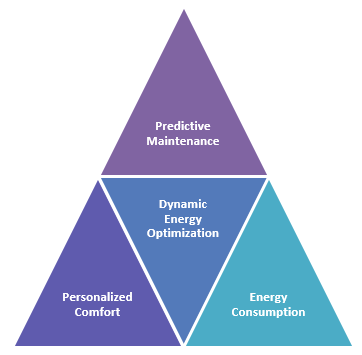
This shift necessitates a new generation of HVAC systems that are intelligent, adaptive, and data-driven. Artificial Intelligence (AI) is central to this transformation. By leveraging machine learning, computer vision, and real-time data from IoT-enabled sensors, AI enables predictive maintenance, personalized comfort control, and dynamic energy optimization. Studies suggest AI-driven HVAC technologies can reduce energy consumption by 20–30%, with some deployments offering up to 40% savings. Furthermore, AI can significantly enhance indoor air quality—improvements up to 65% have been observed.
These capabilities move HVAC systems from reactive to proactive, unlocking efficiencies previously out of reach. This white paper explores how AI is not just enhancing HVAC performance but is rapidly becoming essential to its future in smart, sustainable buildings.
3. Problem Statement
HVAC systems, though critical to indoor comfort and air quality, remain largely inefficient, rigid, and disconnected in their current form. Many operate on outdated control logic—preset schedules and thermostatic responses—without real-time awareness of occupancy, weather changes, or energy price fluctuations. This static operation leads to significant energy waste, suboptimal comfort, and elevated operational costs.
Maintenance models are similarly outdated, relying on fixed service intervals or reactive repair after failure. This not only shortens equipment lifespan but also increases the risk of system downtime, especially during peak demand periods. As buildings become more complex and energy-intensive, traditional HVAC approaches are proving insufficient to meet modern performance, efficiency, and sustainability standards.
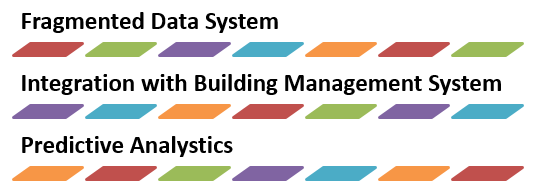
The problem is further compounded by fragmented data systems, poor integration with Building Management Systems (BMS), and the lack of predictive analytics. Despite the increasing digitization of infrastructure, HVAC cybersecurity protocols often lag, creating potential vulnerabilities.
Addressing these challenges demands a transition to intelligent, autonomous HVAC systems capable of sensing, learning, and optimizing in real time—capabilities made possible by artificial intelligence.4. Technology Attributes
Artificial Intelligence introduces a suite of technologies that enable HVAC systems to transition from rule-based, reactive control to dynamic, self-optimizing environments. The following attributes illustrate how various AI techniques are applied across HVAC lifecycle stages—from sensing and control to forecasting and diagnostics.
AI-driven models analyze historical performance data, sensor readings, and environmental variables to detect patterns that precede equipment failure. Supervised learning algorithms can predict component degradation, allowing for condition-based maintenance instead of time-based servicing. This minimizes unplanned downtime (which costs industrial facilities up to $50 billion annually globally) and extends equipment lifespan, with studies showing maintenance cost reductions of 10–40% in AI-optimized systems
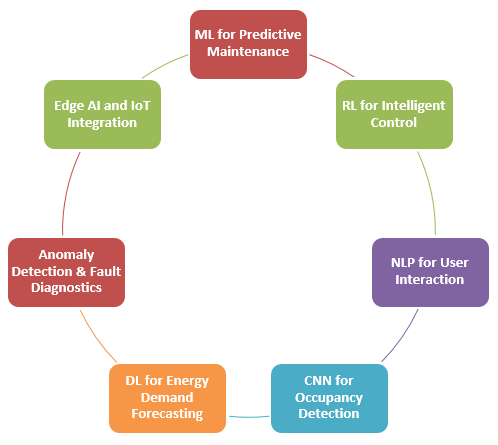
- Machine Learning for Predictive Maintenance: AI-driven models analyze historical performance data, sensor readings, and environmental variables to detect patterns that precede equipment failure. Supervised learning enables condition-based maintenance, reducing unplanned downtime (which costs industrial facilities up to $50 billion annually) and cutting maintenance costs by 10–40%.
- Deep Learning for Energy Demand Forecasting: Deep neural networks process data like weather, occupancy patterns, and energy usage to predict HVAC loads accurately. This reduces energy consumption by 20–30%, leading to potential annual savings of $2 billion in the US alone.
- Reinforcement Learning for Intelligent Control: Reinforcement learning algorithms learn optimal HVAC control policies through trial and error. RL can improve energy efficiency by 15–25% while maintaining occupant comfort.
- Computer Vision for Occupancy Detection: Using convolutional neural networks, AI vision systems detect human presence and activity levels. Occupancy-based control can reduce HVAC energy use by 10–20%, with some reaching 40% by conditioning only occupied zones.
- Natural Language Processing (NLP) for User Interaction: Voice assistants and chatbots offer intuitive HVAC control. 65% of smart home users prefer voice commands, enhancing user satisfaction and responsiveness.
- Anomaly Detection and Fault Diagnostics: Unsupervised methods (e.g., clustering, autoencoders) spot abnormal behavior in systems. Early fault detection can cut energy waste by up to 25% and repair costs by 30–50%.
- Edge AI and IoT Integration: Edge AI enables local processing of HVAC data, reducing latency by up to 90% and ensuring fast response even during connectivity issues.
5. Stage of Development
The development and deployment of AI technologies in HVAC systems have advanced rapidly over the past decade, transitioning from experimental applications to widespread commercial integration. Between 2012 and 2024, there has been a sharp rise in patent filings and technology disclosures related to AI-powered HVAC control, fault detection, and energy optimization—demonstrating a robust innovation pipeline across both industrial and academic sectors.
Commercial adoption is accelerating, with AI now being used for predictive maintenance, adaptive airflow control, energy forecasting, and occupant-aware climate management. Leading HVAC manufacturers such as Johnson Controls, Carrier, Honeywell, and Daikin are actively investing in AI research and forming alliances with technology startups to co-develop next-generation building automation solutions. Platforms like OpenBlue, Abound, and ARIA by BrainBox AI are already operational in thousands of buildings worldwide, highlighting the transition from proof-of-concept to scalable deployment.
Strategic investments in edge computing, cloud-integrated BMS platforms, and digital twins are enabling more sophisticated AI deployment in both new constructions and retrofit scenarios. Governments and regulatory bodies have further supported this evolution by promoting smart building standards and incentivizing AI adoption through green building certifications and energy-efficiency funding mechanisms.
As the HVAC industry continues to confront energy efficiency demands and climate resilience goals, AI has emerged as a critical enabler—moving beyond a theoretical capability to become a cornerstone of modern, intelligent building systems.
5.1 Market Research
5.1.1 Johnson Controls
- Johnson Controls is at the forefront of integrating artificial intelligence into HVAC systems and smart building technologies. Their flagship platform, OpenBlue, leverages AI to enhance building performance, energy efficiency, and occupant comfort.
- OpenBlue Enterprise Manager: This platform utilizes AI to provide tailored energy-saving recommendations based on energy use and weather data. It also offers autonomous controls, allowing buildings to adjust set points based on fault diagnostics, leading to energy savings and improved operational efficiency.
- OpenBlue Digital Twin: A digital replica of assets, processes, people, places, systems, and devices within a building. This AI-infused model helps in predictive maintenance, space optimization, and real-time event response, enhancing overall building management.
- OpenBlue Performance Advisor: An application that supports organizations in achieving clean air and sustainability targets through data tracking software, artificial intelligence, and intuitive dashboards. It monitors indoor air quality, energy consumption, and provides de-carbonization recommendations.
- Energy Savings: Customers have reported up to a 10% reduction in energy costs, with some identifying significant savings by addressing issues like out-of-hours lighting.
- Operational Efficiency: The integration of AI has led to up to a 20% reduction in maintenance spend and 10% more optimized space utilization.
- Return on Investment: A Forrester Consulting study found that organizations deploying OpenBlue could achieve up to a 155% return on investment over three years.
5.1.2 Carrier
- AI-Powered Home Energy Management Systems (HEMS): Carrier has partnered with Google Cloud to integrate its battery-enabled HVAC technology with Google Cloud's AI analytics and Weather Next AI models. This collaboration aims to create intelligent solutions that allow home owners to store energy and use it during peak periods, optimizing HVAC performance for efficiency and cost savings.
- Smart Energy Management Program: In collaboration with Leap, Carrier launched the SmartSave program in major U.S. states, including California, New York, and Texas. This program enables homeowners to optimize HVAC energy use during peak demand or grid events, reducing strain on the grid without compromising comfort. Participants can monitor energy savings and earn rewards through the Carrier Smart-Home app.
- Remote Energy Management: Carrier's EcoEnergy Insights platform, powered by the CORTIX™ Building IoT platform, offers cloud-based analytics to optimize energy efficiency, equipment uptime, and occupant comfort. The platform collects data from multiple sources, analyzes it, and provides actionable insights to enhance building operations.
- Predictive Maintenance: Carrier employs AI algorithms to predict equipment failures before they occur. By analyzing data from sensors installed on HVAC and refrigeration units, the company can detect patterns and anomalies, allowing for proactive maintenance that minimizes downtime and reduces costs.
5.1.3 Honeywell
- Honeywell launched Connected Solutions, an AI-powered building management platform on Honeywell Forge, now used by Verizon and Vanderbilt University for remote monitoring, diagnostics, predictive maintenance, and energy optimization via a unified interface.
- In partnership with Cisco, Honeywell integrates Forge Sustainability+ with occupancy data to autonomously adjust HVAC, lighting, and ventilation—reducing energy use and carbon emissions.
- A 2025 Honeywell survey found 84% of commercial building managers plan to increase AI usage for security, maintenance, energy, and temperature control—indicating strong market demand.
- Currently, 60% of organizations use AI for maintenance and 55% for energy management, with 63% leveraging AI for security and safety.
- The Forge Performance+ for Buildings platform delivers predictive analytics and remote maintenance—helping clients like Amway gain a 15% increase in “Excellent” comfort zones and reduce downtime.
- In 2024, Honeywell partnered with Google (Gemini & Vertex AI) to build generative AI agents atop Forge for autonomous operations, maintenance support, and workflow automation—rolling out to customers in 2025.
5.1.4 Daikin
- In April 2025, Daikin and Hitachi launched a trial of an AI diagnostic agent at Daikin’s factory in Osaka—capable of diagnosing equipment failures in under 10 seconds with over 90% accuracy, utilizing generative AI and knowledge graphs to embed operational knowledge into digital systems.
- Acquisitions in Northern Europe (2024–2025): Daikin expanded its residential heat pump and service capabilities by acquiring Kylslaget in Sweden and BKF Klima in Denmark. These moves enhance Daikin’s regional footprint, bolster installer networks, and support training infrastructure like the newly launched Daikin Training & Experience Center in Denmark.
- Daikin Cloud Plus, launched in 2023, allows remote management of HVAC systems via web/mobile. It enables real-time energy tracking, automated set point adjustments based on occupancy/weather, and feature-rich “if-this-then-that” control logic.
- Daikin’s iPlant Manager and Intelligent Equipment offerings apply AI/ML to optimize plant-room operations, continuously tuning performance to match design efficiency and yielding ~20% energy cost reduction.
- Daikin supports standard BMS protocols (Modbus, KNX, BACnet, LonWorks), enabling seamless integration across diverse systems and dashboards—facilitating remote monitoring and centralized control for small and mid-sized buildings.
5.1.5 LG Electronics
- Multi V™ i: LG's Variable Refrigerant Flow (VRF) system, equipped with an advanced AI engine, offers features like AI Smart Care, which adjusts cooling/heating based on room occupancy and ambient conditions, and AI Energy Management, allowing users to set energy consumption targets. These innovations aim to reduce energy consumption and enhance indoor comfort.
- OhmConnect Partnership: LG has integrated its room air conditioners with the OhmConnect Demand Response program via the LG ThinQ App. This collaboration allows U. S. consumers to earn rewards by automatically reducing energy consumption during peak grid demand periods.
5.1.6 Samsung Electronics
- Bespoke AI WindFree Air Conditioners: Samsung's 2025 models feature AI Fast & Comfort Cooling, which rapidly lowers room temperature and then maintains comfort levels using AI analysis. The AI Energy Mode in the SmartThings app helps reduce energy use by up to 30%.
- ABB Collaboration: Samsung has partnered with ABB to provide integrated smart building solutions. This collaboration combines Samsung's HVAC products with ABB's home automation technologies, facilitating energy savings and enhanced device management through a unified platform.
- SolarEdge Partnership: Samsung signed a partnership with SolarEdge to expand its Net Zero Home ecosystem. By integrating SolarEdge's smart energy solutions with Samsung's heat pumps and SmartThings Energy platform, the collaboration aims to optimize energy consumption and promote energy independence for homeowners.
- Strategic Acquisition: Samsung announced its acquisition of German air conditioning and heating systems manufacturer FlaktGroup for €1.5 billion. This move aims to bolster Samsung's capabilities in providing cooling solutions for high-demand data centers, particularly those supporting artificial intelligence workloads.
6. Benefits
The integration of AI into HVAC systems delivers significant advantages across energy efficiency, operational resilience, and user comfort. Chief among these is the reduction in energy consumption, achieved through real-time adaptive control, predictive maintenance, and dynamic demand forecasting. AI-driven systems can learn occupancy patterns, weather conditions, and usage trends to optimize heating, cooling, and ventilation, thereby minimizing waste and maximizing performance.
In commercial buildings, AI improves equipment lifecycle management by identifying faults early, automating diagnostics, and recommending proactive interventions—reducing downtime and maintenance costs. For utilities, HVAC-AI integration enables load shaping and peak shaving, facilitating better demand response and grid coordination, especially when paired with smart meters and distributed energy systems.
Additionally, AI empowers personalized climate control for occupants, enhancing comfort while aligning with energy-saving goals. These capabilities, combined with reduced carbon emissions and enhanced building automation, underscore AI’s role in creating intelligent, sustainable, and responsive building environments.
7. Barriers and Challenges
Despite its transformative potential, the adoption of AI in HVAC systems is constrained by a set of technical, economic, and regulatory challenges. A primary barrier is the high upfront investment required for AI-compatible sensors, control systems, and retrofitting existing HVAC infrastructure, particularly in older buildings. The return on investment may not be immediate, making it difficult to justify for cost-sensitive facility managers and homeowners.
Another major concern lies in data privacy and cybersecurity. AI-enabled HVAC systems continuously collect granular data on occupant behavior, building usage, and environmental conditions. This raises issues around data ownership, consent, and secure storage, especially in commercial or multi-tenant buildings.
The lack of standardization across building automation systems and IoT platforms also impedes interoperability and large-scale deployment. Many buildings rely on proprietary or legacy systems that are incompatible with newer AI solutions, requiring custom integration and complex system architecture.
Furthermore, regulatory gaps persist. Building codes and energy compliance frameworks in many regions do not yet reflect the capabilities or requirements of AI-driven control systems, creating ambiguity around certification and compliance.
Finally, there is a shortage of specialized talent—engineers and technicians trained in both HVAC system design and artificial intelligence. This skills gap limits the pace of development, deployment, and ongoing maintenance of intelligent HVAC systems.
8. Conclusion
Artificial intelligence stands at the forefront of the next evolution in HVAC technology, transforming conventional systems into adaptive, predictive, and energy-efficient ecosystems. By enabling real-time responsiveness to occupant behavior, weather conditions, and grid dynamics, AI elevates HVAC performance—delivering enhanced comfort, reduced emissions, and substantial operational savings.
As outlined in this paper, leading industry players and research institutions are already deploying AI-driven HVAC solutions, from automated diagnostics and energy forecasting to wireless charging integration and smart building control. Yet, unlocking AI’s full potential requires overcoming significant hurdles: integration complexity, regulatory inertia, data governance, and skills shortages.
A collaborative push—encompassing policy modernization, technology standardization, cross-industry partnerships, and targeted workforce development—is vital to scaling adoption. The path toward intelligent, low-carbon, occupant-centric building environments are now within reach, and AI is the enabling catalyst.