1. Introduction
Electric vehicles (EVs) and green energy sources rely heavily on batteries to store electricity. Currently, more than 75 percent of the world’s energy storage depends on batteries that contain lithium, an expensive mineral that’s subject to volatile pricing. Lithium-ion (Li-ion) batteries themselves can be volatile, too, because they use a flammable electrolyte that can catch fire when overcharged.
Aluminum is more abundant mineral in Earth’s crust and cheaper than lithium. And if built right, aluminum-based batteries may offer longer life expectancy and a safer, more sustainable design than their volatile counterparts.
2. Problems
2.1 The Need for Next-Gen Batteries
Conventional lithium-ion batteries, while revolutionary and have advantages, but are constrained by:
- Limited cycle life
- Scarcity and high cost of critical minerals
- Safety hazards from flammable liquid electrolytes
- Environmental concerns in mining and disposal
- Thermal instability
3. Solution
3.1 Aluminum-Ion Solid-State Concept
Aluminum-ion solid-state batteries use aluminum as the anode, a solid electrolyte, and graphite or other carbon-based materials as the cathode. Unlike lithium-ion systems, Al-ion batteries avoid flammable liquids and rely on trivalent Al³⁺ ions, which offer higher theoretical charge density.
3.2 Core Components of Al-ion (Solid-State)
Core components for Al-ion battery are:
- Anode: Pure Aluminium foil
- Cathode: Graphene, Graphite, or metal oxide
- Electrolyte: Solid-state ceramic, an inert aluminum fluoride salt, polymer, or hybrid materials supporting Al³⁺ conductivity
3.2.1 Reaction Mechanism
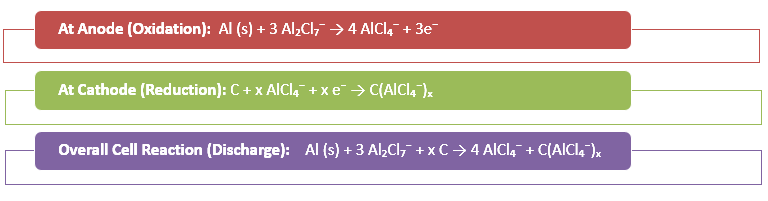
During discharge, Aluminum metal is oxidized and reacts with complex aluminum ions from the electrolyte. Graphite intercalates AlCl₄⁻ ions along with electrons.
During charging, the reactions are reversed, Aluminum is plated back onto the anode and AlCl₄⁻ ions de-intercalate from graphite and recombine to form Al₂Cl₇⁻.
3.3 Overview of Battery Technologies
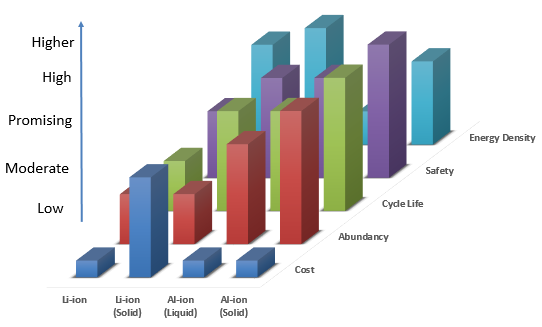
The above graph shows the Promising value of Energy Density for Al-ion(solid state) with the lowest cost and higher availability, Cycle life and safety when compare with other or conventional battery.
4. Proposed Solution: Aluminum-Ion Solid-State Batteries
4.1 Electrolyte Innovations
Traditional Al-ion batteries utilize liquid electrolytes, which can lead to issues such as anode corrosion and dendrite formation. Recent developments have introduced solid-state electrolytes that enhance performance and safety. For instance, incorporating an inert aluminum fluoride (AlF₃) salt into a liquid electrolyte containing aluminum ions leads to the formation of a solid-state electrolyte which improves ion conductivity and stability, facilitating long-term cycling with high Coulombic efficiency.
4.2 Interface Engineering
To mitigate the formation of harmful aluminum crystals, researchers have employed interface additives like fluoroethylene carbonate (FEC). These additives promote the formation of stable solid electrolyte interphases (SEIs), ensuring uniform aluminum deposition and enhancing the battery's longevity.
5. Results/Benefit with Al-Ion battery
5.1 Based on Economical considerations
5.1.1 Material Abundance and Cost
Aluminum is one of the most abundant metals in the Earth's crust, making Al-ion batteries less susceptible to the supply chain issues associated with lithium and cobalt. This abundance contributes to lower material costs and a more sustainable battery production process.
5.2 Based on Environmental Considerations
5.2.1 Recycling Potential
The recyclability of Al-ion batteries is a significant advantage. Studies have demonstrated that the aluminum fluoride framework can be recovered with high efficiency, reducing environmental impact and production costs.
5.2.2 Lower Fire Risk
Most aluminum-ion batteries use AlCl₃-based ionic liquids (e.g., AlCl₃/[EMIm]Cl) as the electrolyte which are non-volatile and non-flammable. Overall, Aluminium-ion battery are more tolerant of overcharging, leakage, and high temperatures, making them safer under extreme or unexpected conditions.
5.3 Based on Performance Metrics
5.3.1 Energy Density
Al-ion solid-state batteries have demonstrated energy densities up to 600 Wh/kg, surpassing that of conventional lithium-ion batteries, which typically range between 150–350 Wh/kg. This increased energy density translates to longer driving ranges for electric vehicles.
5.3.2 Cycle Life
The longevity of Al-ion batteries is a notable advantage. Tests have shown that these batteries can endure over 10,000 charge-discharge cycles with minimal capacity loss, significantly outlasting traditional lithium-ion batteries.
5.3.3 Safety and Stability
Aluminum-ion solid-state batteries exhibit superior safety profiles due to their non-flammable nature and resistance to thermal runaway. Additionally, their solid-state electrolytes offer enhanced physical stability, even under extreme conditions such as puncturing or exposure to high temperatures.
6. Competitive Analysis/Market Outlook
The aluminum-ion battery market is projected to experience substantial growth. The key market for aluminium ion batteries was USD 5.6 billion in 2025, additionally an estimated value of USD 9.5 billion by 2030, expanding at a compound annual growth rate (CAGR) of 5.5% . This growth is driven by the increasing demand for sustainable and high-performance energy storage solutions in sectors such as electric vehicles, renewable energy storage, and industrial applications.
6.1 Regional Market Trends
- a) North America: Increasing demand for aluminium ion batteries in the North American market, especially in the United States and Canada, can be attributed to government drive towards clean energy solutions and flourishing electric vehicle market. Battery research & development investments are driving further market expansion. Expected CAGR (2025-2023) is 5.9%.
- b) Europe: Europe is leading the way towards sustainable batteries, with Germany, France and the UK taking charge of research into aluminium ion batteries. Stringent environmental regulations and a focus on reducing lithium dependence are driving innovation and market growth in the region. Expected CAGR (2025-2023) is 5.6%.
- c) Asia-Pacific: Asia-Pacific expects to lead the battery industry, China, Japan and South Korea is investing in alternative battery technologies. Aluminium ion batteries are gaining popularity with the growing renewable energy sector and the demand for next generation energy storage solutions. Expected CAGR (2025-2023) is 5.7%.
- d) Latin America: Latin America, especially Brazil and Mexico, is entering a period of interest for aluminium ion batteries due to their possible applications in grid storage and electric mobility. "Initiatives to encourage the adoption of clean energy from the government would continue to drive the market penetration.
- e) Middle East & Africa: Middle East & Africa, including UAE, Saudi Arabia, and South Africa, is investigating sustainable battery alternatives to promote integration of renewable sources. Investment in aluminium ion batteries is likely to be spurred by a push to reduce reliance on fossil fuels.
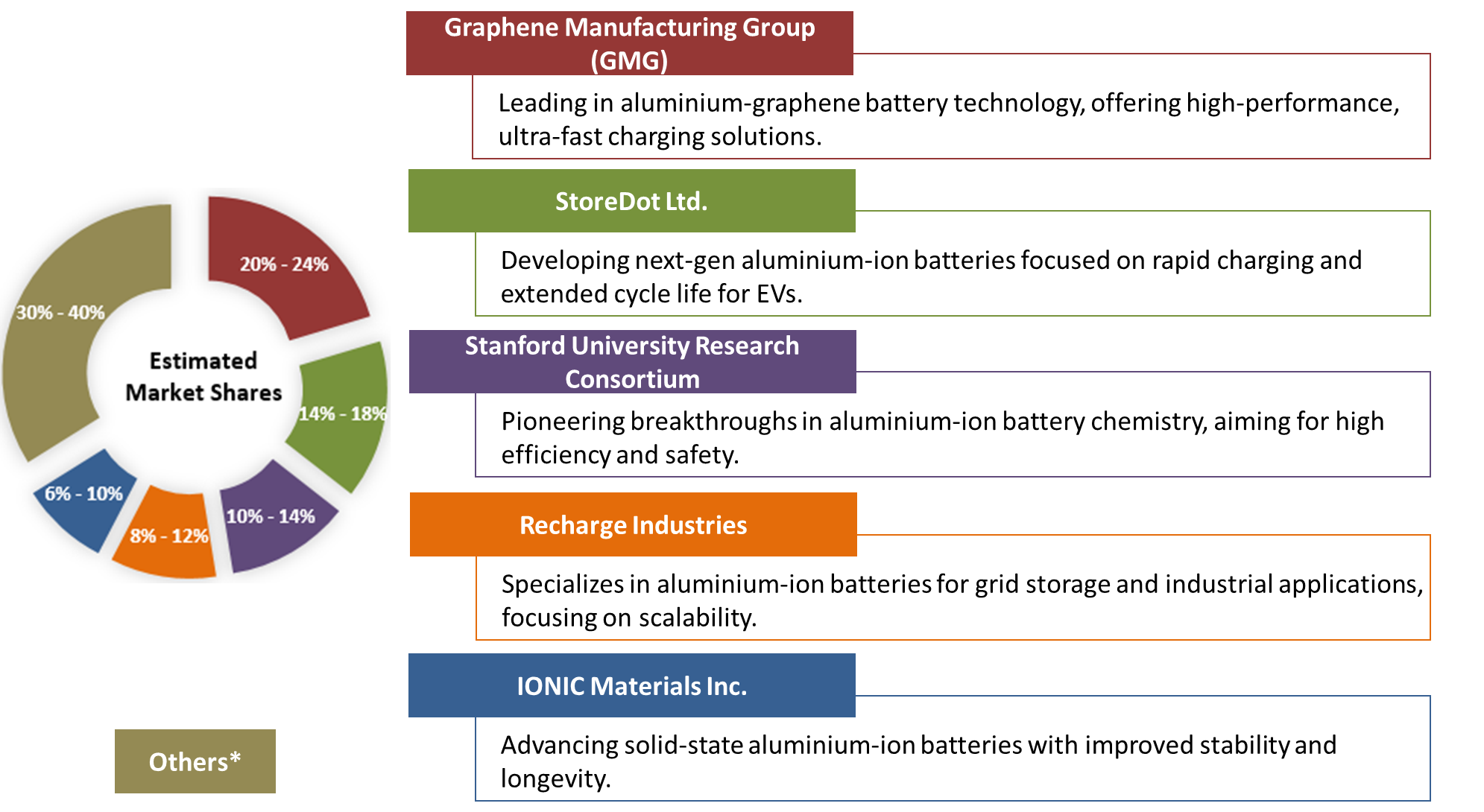
6.2 Market Share Analysis by Key Players & Aluminium Ion battery manufacturers
*Other Key Players (30-40% Combined)
Several emerging players, research labs, and battery technology firms contribute to innovation and commercialization in the aluminium-ion battery sector. These include:
- EnerVenue (Aluminum-based battery solutions for long-duration grid storage)
- BASF Battery Materials (Developing next-gen electrolytes and cathode materials for aluminium-ion technology)
- Amprius Technologies (Advancing aluminium-ion batteries for aerospace and defense applications)
- MIT Energy Lab (Focusing on high-capacity aluminium-ion battery architectures for clean energy transitions)
- Graphene Battery Innovations (Researching aluminium-ion batteries with graphene-enhanced conductivity)
7. Challenges and Future Directions
7.1 Manufacturing Scalability
Transitioning from laboratory-scale production to large-scale manufacturing presents challenges in terms of cost, consistency, and quality control. Standardization of manufacturing processes is essential to ensure the commercial viability of Al-ion batteries.
7.2 Performance Optimization
Further research for cathode material and electrolyte is needed to enhance the energy density and efficiency of Al-ion batteries. Advancements in cathode materials as Aluminum ions (Al³⁺) are small and highly charged, making it difficult to insert them into many common cathode materials, and Electrolyte compositions will be crucial in achieving performance metrics comparable to or exceeding those of current lithium-ion technologies.
8. Conclusion
Aluminum-ion solid-state batteries represent a promising frontier in battery technology for electric vehicles. Their superior energy density, extended cycle life, enhanced safety, and environmental benefits position them as a compelling alternative to traditional lithium-ion batteries. With continued research and development, Al-ion batteries have the potential to play a pivotal role in the future of sustainable electric mobility.