Executive Summary
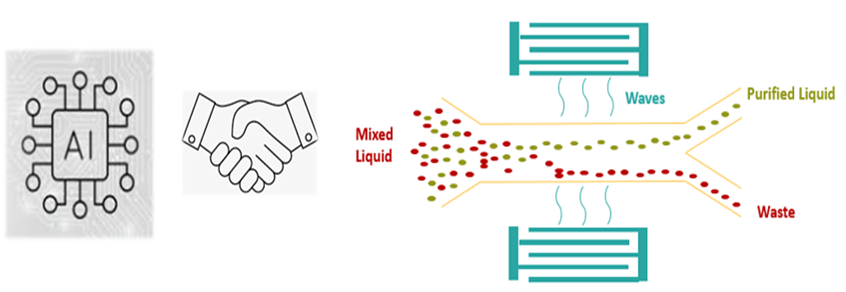
Acoustic Wave Separation (AWS) is an emerging methodology that uses sound waves—typically in the MHz range—to separate, concentrate, or manipulate particles, droplets, and biological cells without physical contact. By leveraging differences in acoustic impedance, compressibility, and density, AWS enables highly selective separation with minimal shear stress. This technology has broad applications in biomedical diagnostics, cell sorting, water purification, industrial processing, and microfluidics.
AI-Based Acoustic Wave Separation (AI-AWS) represents the next major step in this evolution. By integrating machine learning (ML), real-time control algorithms, and physics-informed neural networks (PINNs), AI-AWS systems dynamically tailor acoustic fields to maximize separation efficiency across varying particle sizes, densities, concentrations, and flow conditions.
AWS provides advantages over traditional centrifugation, membrane filtration, and flow cytometry, including reduced energy consumption, lower mechanical stress, scalability from microfluidic chips to industrial reactors, and compatibility with continuous-flow operation.
1. Introduction
Separation technologies are central to biomedical diagnostics, pharmaceutical manufacturing, chemical processing, and environmental remediation. Traditional tools—centrifugation, membrane filtration, field-activated sorting—carry limitations: they require consumables, impart shear stress, or depend heavily on operator adjustments.
AWS alleviates many of these issues but still demands:
- Fine-tuning for different samples
- Careful calibration of acoustic impedance and fluid properties
- Stable thermal and mechanical conditions
- Expertise to achieve high yield and purity
AI-AWS automates these tasks, enabling constant optimal performance in changing environments.
2. ACOUSTIC WAVE SEPARATION_The Physical Basis:
2.1 Key Principles
AWS relies on the acoustic radiation force, which drives particles to pressure nodes or antinodes in a standing wave field based on their acoustic contrast factor.
2.2 System Components
Piezoelectric transducers: A device (often made of materials like lithium niobate or PZT) that converts an electrical signal into mechanical vibrations (ultrasonic waves)
Microfluidic or mesofluidic channels: A small-scale channel, often made of glass or silicon, through which the sample mixture flows in a laminar manner. This channel is designed with specific dimensions (width and length) to match the acoustic wavelength for optimal performance and typically features at least one inlet and multiple outlets for collecting separated components.
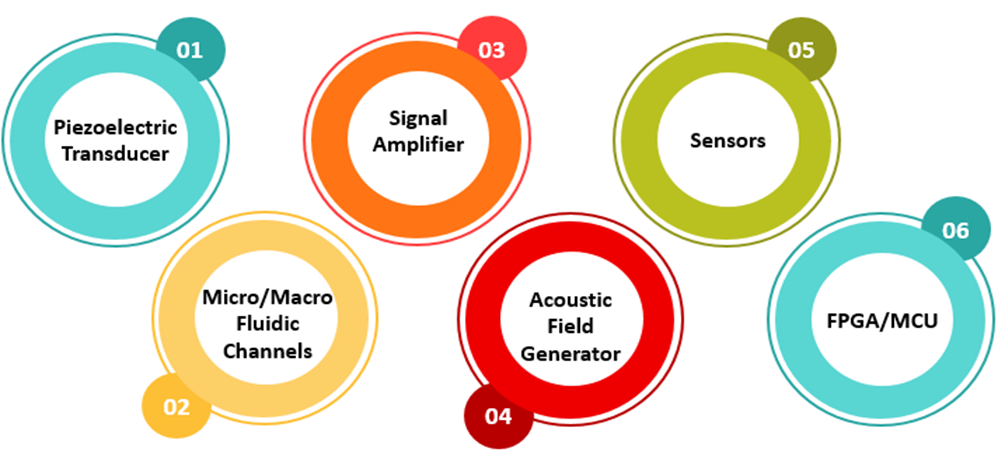
Signal generator/amplifier: An external source (e.g., an alternating current, AC, terminal) that provides the specific electrical signal at a matched frequency to activate the transducer.
Field Generator (Standing Wave): The system generates a standing acoustic wave within the fluid channel. This field creates fixed zones of high pressure (pressure antinodes) and low pressure (pressure nodes).
Sensors like optical, acoustic, impedance, thermal utilizes acoustic principles for sorting particles or measuring properties.
Control electronics (FPGA/MCU): MCUs typically handle high-level control and communication, while FPGAs are essential for the high-speed, real-time signal processing and precise wave generation required for effective particle manipulation.
2.3 Limitations without AI
Acoustic wave separation systems operating without AI integration face several inherent limitations, including static frequency and amplitude settings that restrict adaptability to changing process conditions.
Their performance often declines when there is variability in sample composition, as differences in particle size, density, or material properties cannot be dynamically compensated. These systems typically require manual calibration, increasing labor effort, downtime, and the risk of human error.
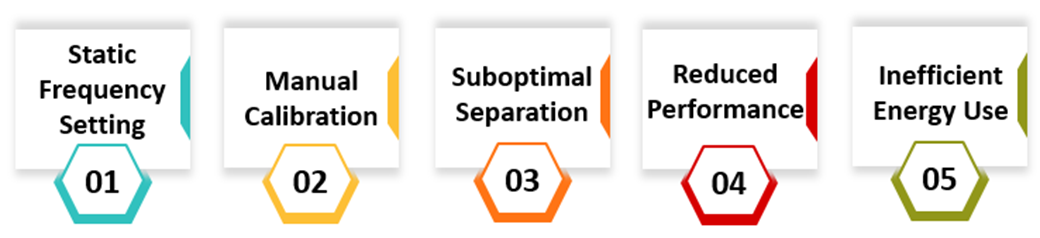
Additionally, the lack of real-time optimization leads to inefficient energy usage, raising operational costs. At high throughput levels, these constraints result in suboptimal separation efficiency due to reduced control over acoustic field behavior and particle interactions.
3. AI INTEGRATION_TRANSFORMING AWS INTO A SMART AUTONOMOUS SYSTEM:
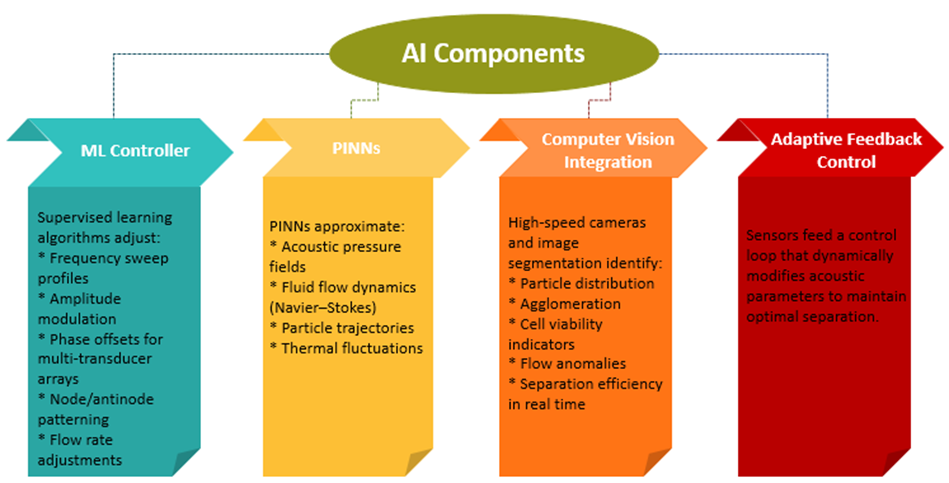
AI-AWS uses data-driven and physics-driven methods to intelligently manage acoustic fields.
3.1 AI Components
4. SYSTEM ARCHITECTURE OF AI-AWS:
4.1 Hardware Stack
- Transducer array: LiNbO₃/PZT transducers arranged for standing/traveling waves
- Real-time sensors:
- optical microscopy
- infrared thermal sensors
- acoustic backscatter
- flow meters
- Edge AI module: GPU/TPU/FPGAs for real-time inference
- Thermal management: ensuring stable acoustic performance
- Fluidic module: microfluidic to large-scale flow channels
4.2 Software Stack
Data acquisition layer: The process of collecting, measuring, and converting real-world data and information into a digital format that can be stored, processed, and analysed by a computer.
Physics simulation kernel (AI-accelerated): Use for speed up traditional physics simulations by reducing runtimes and computational costs
ML inference layer: for prediction generations or make decisions on new, unseen data.
Control decision engine: Which automates complex decision-making processes by applying predefined rules, logic, and data analysis to produce an outcome.
User interface/dashboard: A computer information systems which provides at-a-glance views of data relevant to a particular objective or process through a combination of visualizations and summary information.
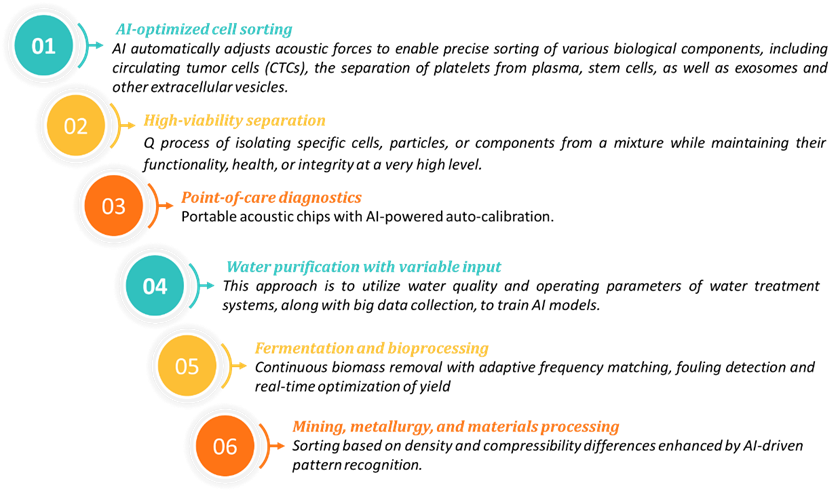
5. APPLICATIONS AREA:
6. ADVANTAGES OF AI-AWS:
6.1 Quantitative Improvements (typical experimental ranges)
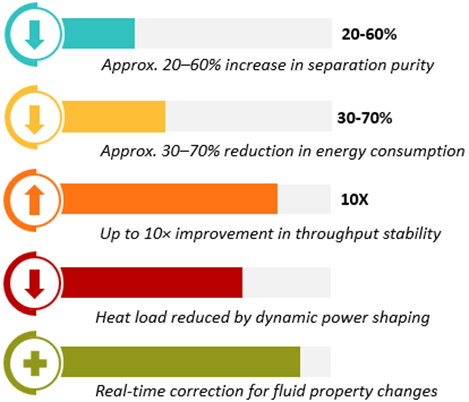
6.2 Operational Advantages
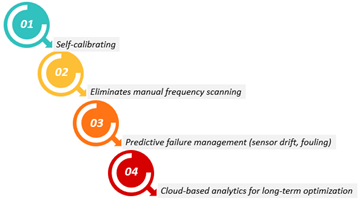
7. IP Activity in Acoustic wave separation
As part of our analysis of patent activity in aluminium ion technologies in electric vehicle, an IP study was conducted to identify patents related to this technology and a total of 2131 applications were selected for final analysis.
7.1 Relevant keywords, synonyms and classes used for search
- AI, ML, Artificial Intelligence, Machine Learning
- Acoustic wave, Sound wave, Acoustic Signal, Sound Signal, Acoustic Layer
- Separation, Filter, Segregation, Break-up
- Vibration, Shaking, Quaking
- Relevant patent classification includes: C12N13/00, B01L2400/0436, B06B1/06
- TACD:(((artificial w2 intelligence) OR (machine w2 learning) OR AI OR ML) ws (((acoustic OR sound) w2 (wave OR signal)) ws (separat* OR filter* OR distribut* OR segregat*))) ~ 2131 EFAM
7.2 Graphical Analysis from the identified patents (2131 patent applications):
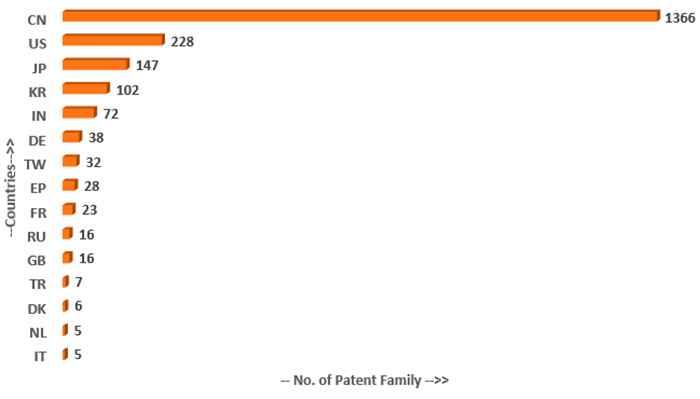
Figure 8 shows the distribution of patents across priority countries (top 15), providing insight into major R&D locations for AI-based Acoustic wave separation, China has most patents family i.e., 1366, followed by US with 1366 patents family. India took 5th position
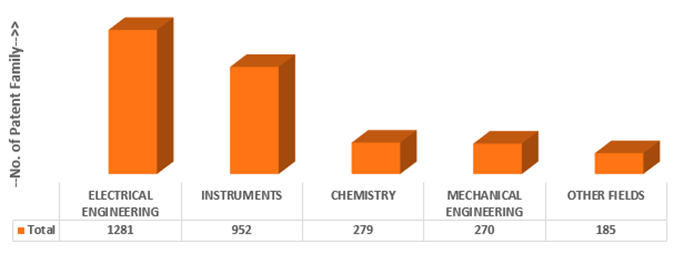
Figure 9 shows the application area of Al-based Acoustic wave separation with a major focus on Electrical, with 1281 patents family in this domain. Instrumentation hold at second place, with 952 patents family.
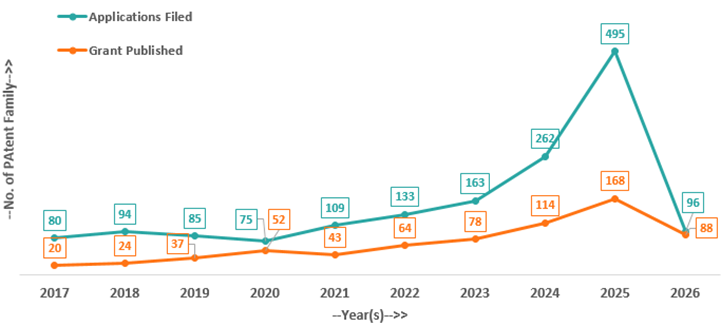
Figure 10 shows patenting trends, with continuous growth Granted patent from 2020 to 2025 and reaches its top. 2025 shows most filled applications as well as Grant published.
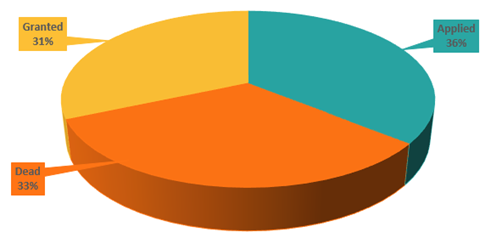
Figure 11 shows a pie chart demonstrating the total number of active (granted and applied) and inactive patents, with 67% patents categorized as “Active" and 33% as “Dead". Out of “Active” patent 31% are “Granted” and 36% are “Pending” application.
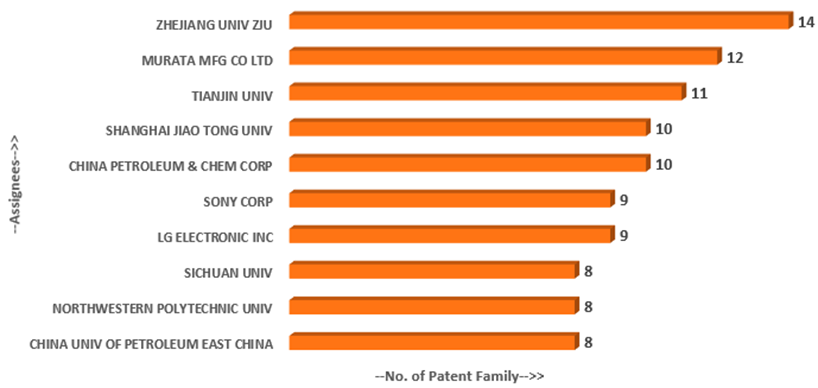
Figure 12 shows top patent assignees, with the Zhejiang Univ. leading with 14 patents, followed by the Murata mfg co. ltd with 12 patents.
8. MARKET ANALYSIS:
8.1 Market Size
Specific market size data for the intersection of "AI" and "acoustic wave separation" is limited, as the technology is largely in the research and development phase or integrated into broader microfluidic systems.
However, the overall acoustic wave sensor market is projected to reach over USD 3.85 billion by 2032 with expected annual growth rate (CAGR) of 12.9%.
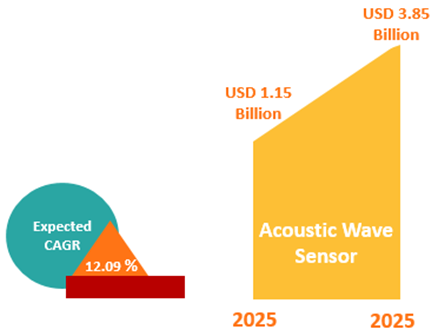
The projected growth in the forecast period is driven by rising demand for real-time monitoring solutions, wider adoption of smart infrastructure, increased use in medical diagnostic devices, expansion of Internet of Things (IoT) ecosystems, and the growing need for low-power, high-efficiency sensors. Key trends in the forecast period include progress in miniaturization technology, innovations in piezoelectric materials and integration with wireless communication systems, ongoing research in biosensing applications, and the development of multifunctional sensor platforms.
9. ROADMAP & FUTURE DIRECTIONS:
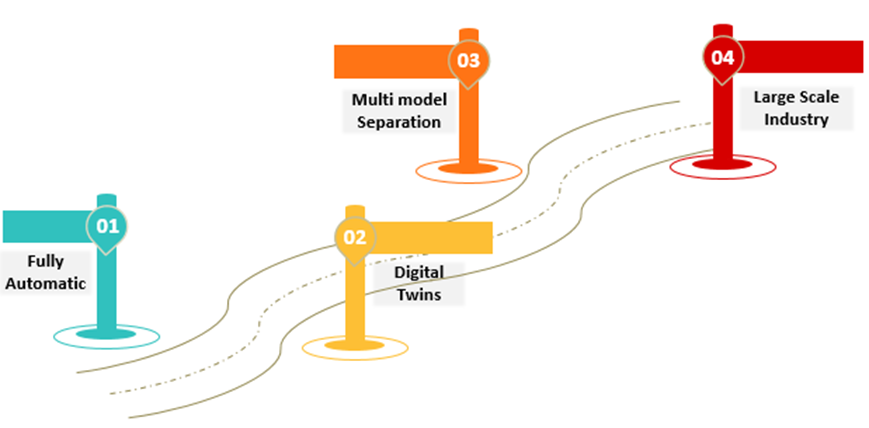
- Fully self-tuning AWS devices that adapt to any sample.
- Digital Twins: Full multiphysics digital twin of the system which is continuously updated by AI.
- Multi-Modal Hybrid Separation for dielectrophoresis, magnetophoresis, optofluidics and inertial microfluidics.
- AI-driven control of large-scale acoustic reactors in industry for oil-water separation, high-volume water treatment and food and beverage clarification.
10. CONCLUSION:
AI-Based Acoustic Wave Separation represents a transformative leap forward in precision, efficiency, and scalability. By merging the non-invasive physical advantages of acoustic forces with the predictive and adaptive power of AI, this technology enables: higher purity, higher throughput, lower energy cost, broader applicability, autonomous and robust operation. AI-AWS is positioned to become a foundational platform across biomedical diagnostics, industrial filtration, environmental remediation, and advanced manufacturing.