Executive Summary
As the global population is increasing rapidly, so is the demand of food. Conventional methods of agriculture are struggling to maintain the productivity due to factors like degradation of soil and overuse of chemical fertilizers. Biofertilizers use microorganisms to improve the plant growth, and can be used instead of chemical fertilizers to improve the soil fertility and crop yield. However, they are limited by slow action and low nutrient uptake. To address these limitations nano-fertilizers are developed that are composed of nano-sized particles allowing targeted nutrient delivery, and improved nutrient absorption. However, accumulation of these particles in the soil lead to soil toxicity and disruption in soil biome.
Nano-biofertilizers were created to solve these existing problems by combining the benefits of bio-fertilizers and nano-fertilizers. They enhance the nutrient delivery and efficiency in the plants. Various kinds of biofertilizers such as Rhizobium, Mycorrhiza, Clostridium, Azotobacter, Rhodobacter, etc., and nanoparticles like silicon nanoparticles, silver nanoparticles, iron nanoparticles, copper nanoparticles, nickel nanoparticles, etc., can be used for the preparation of nano-biofertilizers.
1. Introduction
As there is increase in global human population day by day, it has considerably reduced the agricultural land affecting the food and supply demand ratio heavily. Due to this increasing population, a significant rise in agricultural production is required to meet the current demands. However, there has been a decrease in production with the conventional agricultural methods. The agricultural productivity majorly depends on the quality of soil and the environment, along with other factors such as climatic conditions and water. Soil plays the key role in meeting the demands of world’s food production. As the demand for food continues to rise, there is a growing need for more intensive crop cultivation and overall agricultural production.
The earth crust is the natural habitat for diversity of microorganisms. Decrease in soil fertility has become one of the major concerns for food security. These microbes contribute to a wide range of functions that help to manage the soil health and crop productivity. They control the fertility of soil by modifying the properties of soil either indirectly or directly as the interaction between plant and microbes is one of the most important aspects for agricultural system.
2. Bio-fertilizers
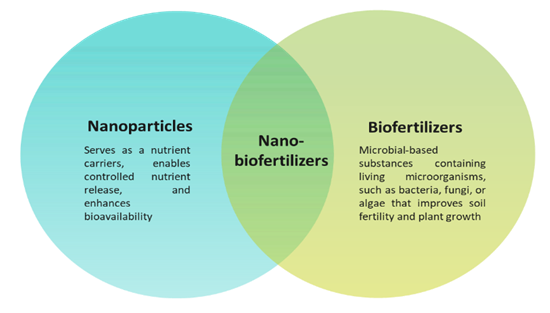
Bio-fertilizers are substances that contain live microorganisms, such as bacteria, fungi, and algae that stimulate plant growth by enhancing the bioavailability of essential nutrients. They improve the soil fertility by formation of growth-promoting substances such as hormones, solubilizing soil-bound nutrients, and fixing atmospheric nitrogen. As bio-fertilizers are a sustainable and environment friendly substitute to chemical fertilizers, they help to improve soil health, enhance the crop yields, and contribute to agricultural productivity.
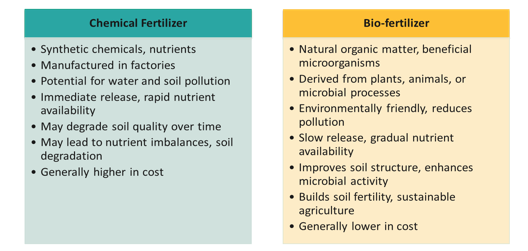
Although bio-fertilizers offer numerous benefits, they also come with limitations such as slow action, delayed release, low rate of uptake, etc. This indicated the need for an improved solution that retains the advantages of bio-fertilizers while overcoming their shortcomings.
3. Nano-fertilizers
Nanotechnology-based fertilizers, known as nano-fertilizers, are designed to increase nutrient effectiveness and support sustainable agricultural practices by using nano-sized particles (that are typically 1 to 100 nanometres in size) to deliver nutrients more effectively in plants. These particles have better absorption and specifically targeted delivery of nutrients like phosphorous, potassium, and nitrogen due to their small particle size that is small enough to penetrate into the plant cells. This ensures availability of these particles to plant roots for a longer period of time minimizing the risk of nutrient wastage and the need for multiple applications.
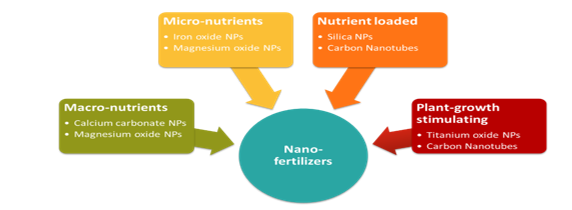
Even though, nano fertilizers is a very good alternate to biofertilizers, they still have drawbacks. Some of them are accumulation of chemical nanoparticles in soil and water with the ability to cause toxicity for non-target organism, disruption in soil microbial communities over time, the controlled releasing of nutrients may not be able to align with the plant’s needs, etc.
4. Nano-biofertilizers
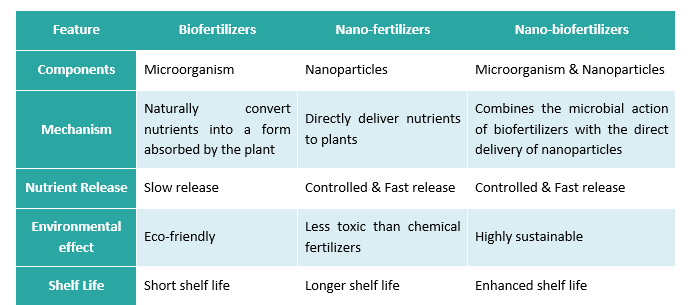
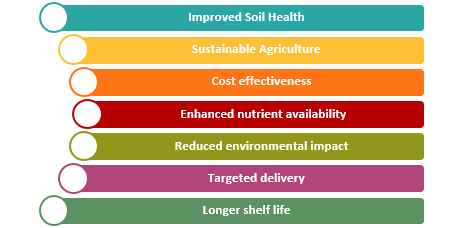
Recently, the incorporation of nanotechnology with biofertilizers has been observed to be a promising trend aimed at enhancing soil health and fostering environmental sustainability. One of its latest advancement is “nano biofertilizers” which combines the advantages of biofertilizers with the advanced delivery mechanism that is enabled by nanomaterials resulting in the ability to minimize the environmental impact that is associated with nutrient loss, increase the nutrient efficiency, and also addresses potential environmental risks.
4.1 Definition of Nano-biofertilizers
4.2 Components of Nano-biofertilizers
There are two main components of nano-biofertilizers:
- Nanoparticles, and
- Biofertilizers.
4.2.1 Nanoparticles
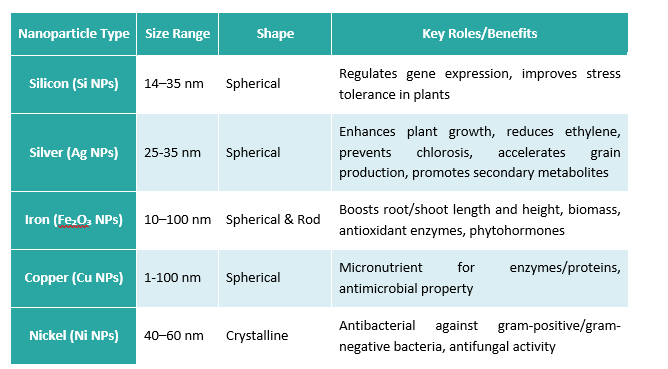
Nanoparticles typically range between 1 to 100 nanometres (nm) in size. The most frequently used nanoparticles in the preparation of nano-biofertilizers are made of silicon, iron, copper, and silver. The shape, size, chemical make-up, and aggregation of the state of the nanoparticles alters their accumulation and absorption properties in plants.
4.2.1.1 Types of Nanoparticles
There are many types of nanoparticles being used for the production of nano-biofertilizers. Silicon, copper, iron, silver are the most commonly used types of nanoparticles.
4.2.2 Biofertilizers
Biofertilizers are microbial inoculants containing cells of living microorganisms used to increase the crop productivity. Their interaction enhances the biological activity in the rhizosphere of plants. These microorganisms increase the amount of nutrients available to plants by enhancing biological N₂ fixation (BNF) and solubilizes insoluble complex compounds into simpler ones that can be accessed by plants. Any microbe of our choice can be used for the formulation of biofertilizers. However, organic materials are required for their establishment and multiplication. They may be present inside the plant as endo-symbionts (e.g., Rhizobium, Mycorrhiza, Anabaena, Arbuscular, etc.) or may invade the rhizosphere (e.g., Clostridium, Azotobacter, Rhodobacter, Pasteurianum, Azospirillum, etc.).
4.3 Mechanism of Nano-biofertilizers
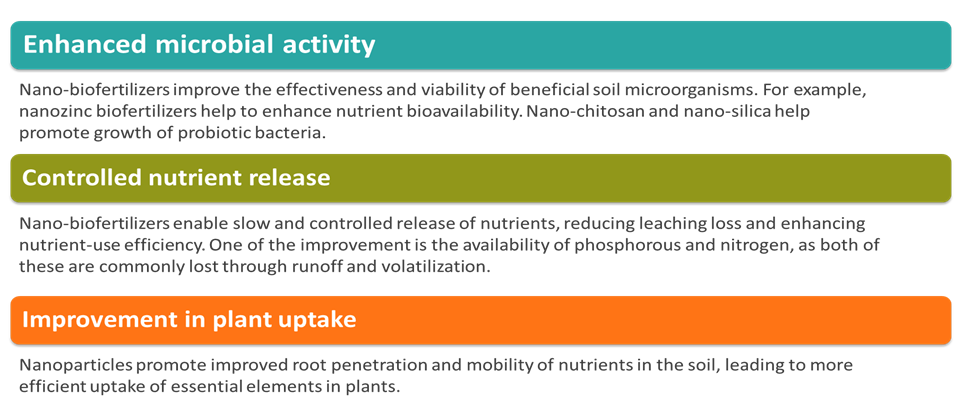
Nano-biofertilizers function through various mechanisms, including soil retention, nutrient delivery, and plant uptake, that collectively makes them superior to other conventional fertilizers.
4.4 Advantages of Nano-biofertilizers
5. PGPM derived nano-biofertilizers
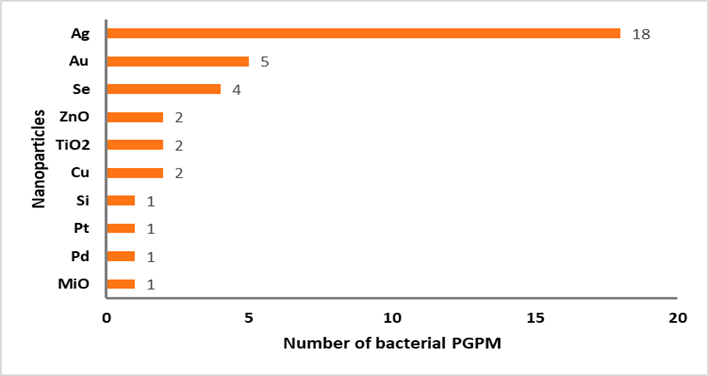
PGPM (Plant Growth-Promoting Microbes) are the beneficial bacteria that has the ability to synthesize both intracellular and extracellular nanoparticles. The metabolites of PGPM help in capping of the nanoparticles and increase their bio-absorption and efficiency. The ability of PGPM as growth enhancers, nitrogen fixers and disease suppressors helps them to be a suitable source for the synthesis of nano-biofertilizers.
Globally, many researchers have reported the utilization of PGPM, including Bacillus spp., Pseudomonas spp., Streptomyces spp., etc., for the biosynthesis of nanoparticles using metals such as silver, gold, carbon, copper, silica, ZnO, and TiO₂. These PGPM-derives nano-biofertilizers have shown effective results promoting crop yield, plant growth, and pest resistance.
6. IP Activity in Nano-biofertilizers
As part of our analysis of patent activity in nano-biofertilizers, an IP landscape study was conducted to identify patents related to the use of nano-biofertilizers. A total of 244 patents application were analyzed and 99 patent applications were selected for final analysis.
6.1 Relevant keywords, synonyms and classes used for search
- Bio-nanofertilizers, microorganisms with nanofertilizers, microbes with nanofertilizers
- patent classification includes C05F17/20, C05G3/80, Y02A40/20, C05C11/00, C05G3/00.
6.2 Graphical Analysis from the identified patents (99 patent applications):
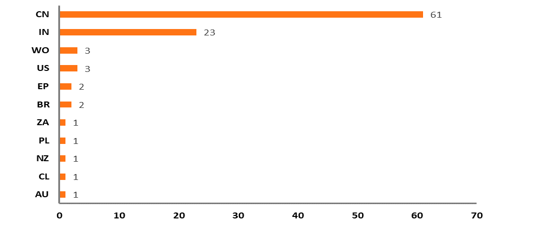
Figure 7 shows the distribution of patents across priority countries, providing insight into major R&D locations for nano-biofertilizers, China (CN) has most patents i.e., 61, followed by India (IN) with 23 patents.
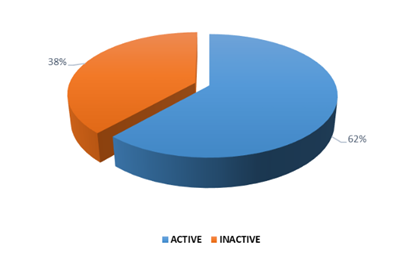
shows a pie chart demonstrating the total number of active and inactive patents, with 61 patents categorized as “Active" and 38 as “Inactive".
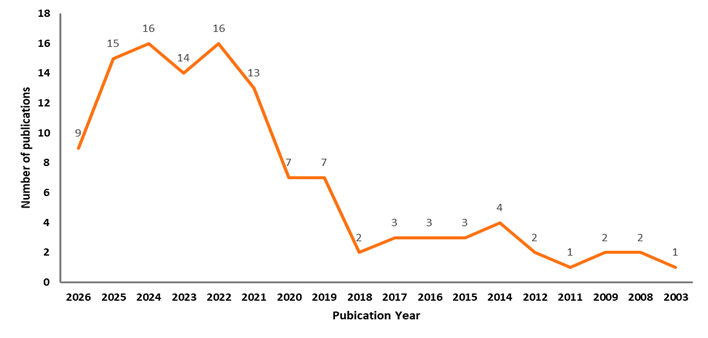
shows the trend of publication of patent applications from 2003 to 2026 with a sudden rise in publication from 2019. 2022 and 2024 have maximum patent applications being published (i.e., 16 patent applications), followed by 2025 and 2023 with 15 and 14 patent applications respectively.

7. Market and Commercial Outlook
Nano-fertilizers Market Size: The market size of nano-fertilizers is calculated to be USD 614.81 million in 2025. Its size is expected to grow from USD 709.47 Billion in 2026 to approximately USD 2,502.79 Billion by 2035, growing at a CAGR of 15.07%
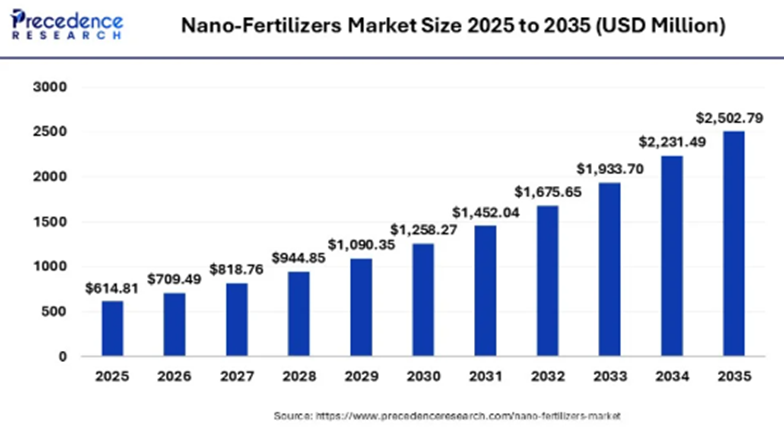
Source :https://www.precedenceresearch.com/nano-fertilizers-market
It also includes the use of nano-fertilizers to increase abiotic stress resistance when they are combined with microorganisms to form nano-biofertilizers.
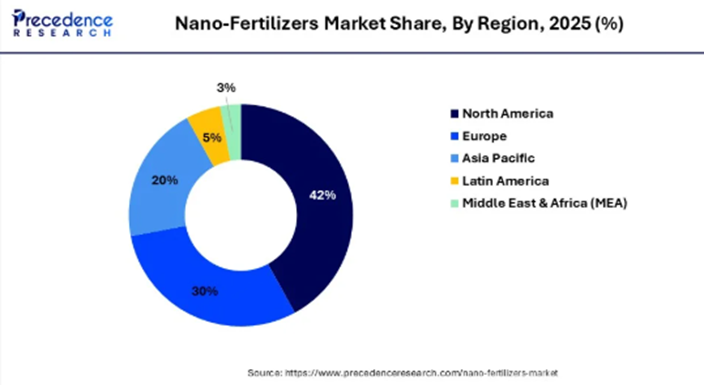
Source:https://www.precedenceresearch.com/nano-fertilizers-market
From the pie chart it can be seen that the nano-fertilizers are most widely used in North America. Because of their reliance on agriculture, countries like India and China are expected to expand the quickest in the Asia Pacific area during the next five years.
8. Future Outlook and Research Directions
While nano-biofertilizers play a positive role sustainability of agriculture, further research is required to study the long term impact of nanoparticles under various soil and crop conditions like soil health, plant health, quality of plant, etc. Nano-biofertilizers can also be used with biosensors for remote sensing and precision farming.
Further research is required to completely understand the effect of nano-biofertilizers and how it can be used. While nano-biofertilizers are still in their early stages, they hold great potential as an alternative of conventional fertilizers being used.
9. Conclusion
Excessive use of chemical fertilizers has increased crop yield but for short period of time, as it compromises the plant quality affecting the human health as well. Due to their soil degrading property, farmers are forced to replace them. Biofertilizers are better alternative for chemical fertilizers but due to their slow nutrient release ability, they were also replaced by nano-fertilizers. Nanoparticles used in nano-fertilizers improve the quality of soil resulting in better crop yield. However, the nanoparticles that were not absorbed by plants are left behind and can accumulate, causing toxicity in the soil.
Nano-biofertilizers are the next generation fertilizers comprising the benefits of both biofertilizers and nanoparticles while simultaneously overcoming their drawbacks. Variety of nanoparticles such as silicon nanoparticles, silver nanoparticles, iron nanoparticles, copper nanoparticles, nickel nanoparticles, etc., can be used in nano-biofertilizers that further results in healthier soil. They work by enhancing the microbial bioavailability, controlled nutrient release, and improved plant uptake.