Executive Summary
Biofabricated skin is a promising next-generation alternative to traditional skin grafts, overcoming challenges such as scarring, donor-site morbidity, and immune rejection. By integrating living cells, biomaterials, and advanced technologies like 3D bioprinting, electrospinning, and organoid engineering, it provides enhanced functional, aesthetic, and regenerative outcomes. Innovations such as vascularized constructs, smart drug-delivery systems, and personalized pigmented grafts expand its effectiveness in wound healing, burn care, and cosmetic dermatology. With ongoing efforts toward full biomimicry, neural integration, scalability, and accessibility, biofabricated skin is expected to play a central role in regenerative medicine and aesthetic reconstruction.
1. Introduction
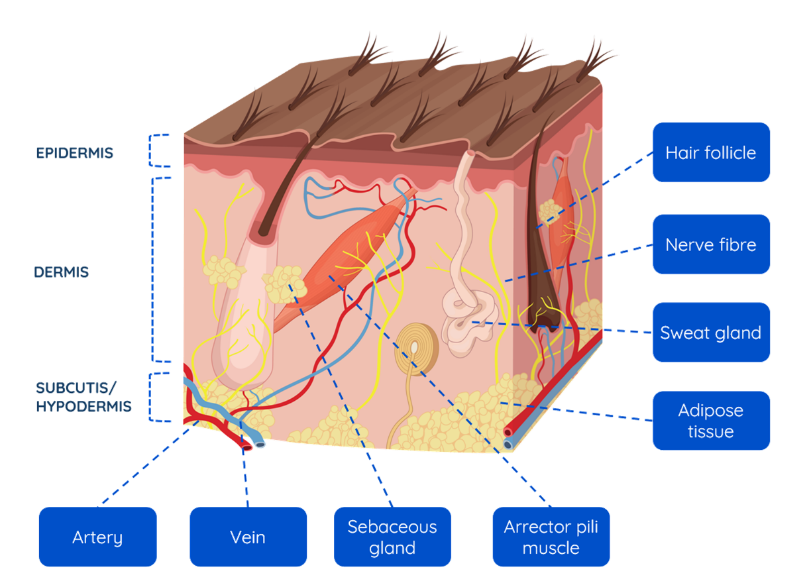
The human skin is the complex, multilayered organ comprising Epidermis, dermis, hypodermis with multiple cell types such as collagen, melanocytes, keratinocytes, fibroblasts, elastin, nerves and sweat glands. Skin plays an important role in protection, thermoregulation, and synthesis of vitamin D and regulation of vitamin B.
Skin injuries such as burns and chronic wounds are common and often difficult to treat with traditional skin grafts due to scarring, donor-site complications, and limited skin availability. Biofabricated skin provides an advanced alternative by combining living cells, scaffolds, and bioactive molecules to mimic natural skin structure and function. Technologies such as 3D bioprinting and stem cell engineering enable the development of multi-layered, vascularized skin constructs that promote effective healing. These innovations reduce scarring, improve recovery outcomes, and are transforming wound care, burn treatment, reconstructive surgery, and cosmetic dermatology.

2. Skin Biofabrication
Skin biofabrication is the process of creating artificial skin using live cells and biomaterials to replicate natural skin structure and function. It involves technologies like 3D bioprinting, where layer of cells and scaffolds are precisely deposited to form skin tissue. This engineered skin can be used for treating burns, wounds and skin diseases, offering an alternative to traditional grafts. The goal is to produce skin that integrates well with the body and promotes healing.

3. Problem: limitations of traditional skin repair

4. The Solution: Biofabricated Skin
Biofabricated skin is an advanced, lab-engineered construct designed using a combination of living cells such as keratinocytes, fibroblasts, melanocytes, endothelial cells, and stem cells which work together to replicate the behavior of real skin. These cells are supported by biometric scaffolds made from natural or synthetic extracellular matrix (ECM) materials that provide structural integrity and guide tissue regeneration. Biofabricated skin also incorporates essential growth factors and bioactive molecule to enhance healing and tissue regeneration. Unlike traditional grafts, it is capable of including functional elements like sweat glands, hair follicles and nerves. This allows it to restore both the appearance and full functionality of damaged skin.

5. How Biofabricated skin overcomes traditional challenges

6. Different Biofabrication Techniques

7. Key innovation and Recent Advancements

7.1. Vascularized 3D-Printed Skin Constructs:
A Swedish team developed artificial skin using two complementary 3D bioprinting approaches: one with a bioink composed of fibroblasts embedded in gelatin grains in a hyaluronic acid gel, and another method called refresh, which uses hydrogel filaments that form customizable, enzyme-removable channels acting as a blood vessel. In vivo mouse studies showed dermis regeneration and vascularization in implanted grafts. It is considered as a major advancement because vascularization is a long-standing barrier in thick skin constructs.
7.2. Hybrid Bioinks with Adipose derived ECM and alginate:
A recent study (2025) introduced a “hybrid bioink” made of adipose-derived decellularized extracellular matrix and alginate. It was optimized to support adipogenesis, proper nutrient/oxygen diffusion, reduce unwanted migration of precursors, and when assembled with dermis modules, promoted wound healing in mice via re-epithelization, tissue remodeling, and angiogenesis. This shows promise in integrating adipose tissue biofabrication into skin grafts.
7.3. Photo-Activated Silk-Collagen-like Protein Hydrogel (“PASCH”):
Researchers in India developed a lab-made collagen like protein hydrogel, activated by visible blur light and riboflavin to form stable crosslinks without harmful UV or toxic chemicals. The gel called PASCH, is porous, flexible, retains moisture, helps reduce inflammation, and accelerates wound closure. It’s being modified especially for diabetic wounds and burns.
7.4. Three-Layer ECM-Based Biogel Skin Substitute:
Collaboration in Spain engineered a 3-layer biogel based on an extracellular matrix component to mimic epidermis, dermis and hypodermis. It serves as a bioactive skin substitute that accelerate regeneration, offering better architecture and skin layer modeling than simpler scaffolds.
7.5. Self- Healing Hydrogels inspired by skin mechanics:
Researchers from Aalto and Bayreuth developed hydrogels that combine strength, flexibility, and autonomous self-healing. By integrating ultra-thin clay nanosheets with entangled polymer networks, they achieved materials that recover from damage, mimic some mechanical properties of human skin, and may be used in dressings, artificial skin, or in responsive wound healing applications.
8. Key Applications

9. IP Activity in Biofabricated Skin
As part of our analysis of patent activity in biofabricated skin, an IP landscape study was conducted to identify patents related to the biofabricated skin as an alternative to traditional skin grafts. A total of 334 patents application were analyzed.
9.1 Relevant keywords and synonyms used for search
- Biofabrication, Bioprinting, Biomanufacturing, Tissue Engineering, Biomesh, Bioprostheses, Biodesigning, Biomimetic
- Skin, Epidermis, Dermis, Derma, Integuments
- Alternatives, Different, Another, Substitutes, Replacement, Surrogates
- Traditional, Conventional, Regular, Establishing
- Skin Grafts, Dermatoplasty, Cutaneous Transplant, Dermal Transplant, Epidermal Transplant, Cutaneous Transfer, Dermal Transfer, Epidermal Transfer
9.2 Graphical Analysis from the identified patents (563 patent applications):

Figure 7 shows the distribution of patents across priority countries, providing insight into major R&D locations for Biofabricated skin, China has most patents i.e., 203, followed by US with 96 patents. The top assignee Prellis Biologics Inc. holds most patents in Chinese Jurisdiction.

Figure 8 shows a pie chart illustrates the distribution of patents by status, with 260 classified as Active and 303 as Inactive.

Figure 9 Shows top patent assignees include Prellis Biologics Inc, leading with 16 patents focused on advancing biofabricated skin as an alternative for traditional skin grafts. This is further followed by Incyte Corp with 13 patents and Stanford University with 12 patents.
10. Market and Commercial Outlook
The bioengineered artificial skin market size has grown rapidly in recent years. It will grow from $2.73 billion in 2025 to $3.07 billion in 2026 at a compound annual growth rate (CAGR) of 12.4%. The growth in the historic period can be attributed to increasing incidence of burn injuries, rising prevalence of chronic wounds, expansion of reconstructive surgical procedures, advances in tissue engineering research, growing availability of biomaterial technologies.

The engineered skin material segment represents the dominant force in the regenerative artificial skin market, capturing approximately 33.0% of total market share in 2025. This advanced category encompasses formulations featuring cellular components with dermal-epidermal architecture, delivering comprehensive biological wound coverage with active tissue regeneration capabilities for complex burn injuries.

10.1 End-use Insights
Burn care centers applications dominate the regenerative artificial skin market with approximately 48.5% market share in 2025, reflecting the specialized expertise and infrastructure requirements for managing severe thermal injuries requiring advanced wound coverage technologies. The Hospitals segment represents 27.0% market share through general surgical departments, plastic surgery units, and emergency departments treating acute burns. The Clinics segment accounts for 24.5% market share, featuring outpatient wound care facilities, diabetic foot clinics, and dermatology centers managing chronic wounds and surgical reconstruction procedures.

11. Future Directions
Biofabricated skin in wound healing and cosmetics aims to enhance its functionality, accessibility, and clinical translation. A major focus is on achieving full biomimicry by incorporating skin appendages like hair follicles, sweat glands, melanocytes, and nerves to restore both form and function. Advanced research is exploring immune-responsive grafts and neural integration for better physiological response and sensory restoration. Smart skin constructs with self-healing hydrogels, embedded biosensors, and stimuli-responsive drug delivery systems are also being developed to improve healing and reduce complications. Cosmetically, there is a push for pigmented, scar-free grafts customized for aesthetic and reconstructive needs. Integrating adipose tissue and building multi-layered constructs with volume restoration capabilities enhances realism and function. Ethical and regulatory progress is needed through GMP-compliant manufacturing, standardized in vitro skin models, and long-term clinical trials. Hybrid biofabrication strategies combining bioprinting, electrospinning, dECM, and cell sheets are optimizing graft structure. Lastly, innovations are focusing on global accessibility through low-cost skin kits and portable bioprinters for use in case of low-resource and emergency.
12. Conclusion
Biofabricated skin represents a groundbreaking advancement in regenerative medicine, offering a viable and superior alternative to traditional grafting techniques. By combining live cells, bioactive scaffolds and advanced fabrication technologies, it enables the creation of skin constructs that restore both the appearance and full functionality of damaged tissue. These innovations address key limitation of current treatments including scarring, donor site complications, and immune rejection while opening new possibilities in wound care, aesthetics and drug testing. As research advances towards fully biomimetic, vascularized, and sensory-integrated skin, the clinical and cosmetic potential of biofabricated skin continues to expand